At the still point of the turning world. Neither flesh nor fleshless;
Neither from nor towards; at the still point, there the dance is,
But neither arrest nor movement. And do not call it fixity,
Where past and future are gathered. Neither movement from nor towards,
Neither ascent nor decline. Except for the point, the still point,
There would be no dance, and there is only the dance.~ T.S. Eliot, 1936, “Burnt Norton”
Still Point Theory
A theory of everything, and one thing.
— Track List —
Intro (4:00)*
Einstein and His Doubt (22:00)
Quanta and Their Weirdness (45:00)
Time and Its Flows (58:00)
Energy and Its Ticks (56:00)
Relativity and Its Records (50:00)
Gravity and Its Axes (55:00)
Outro (1:00)
Bio (3:00)
Feat.
*Runtimes may vary depending on individual turntable calibration
~
— Intro —
Dear Readers,The following seventy-five page thesis is my humble offering for a new kind of exploration into physics, and science and philosophy at large. With it I hope to reunite the estranged elders of this scientific age: the theory of general relativity, and the theory broadly known as quantum mechanics, suggesting a new foundation for both, and hopefully much more (including new descriptions of time, consciousness, energy, and gravity — so perhaps not so humble an offering actually, but I genuinely do so with humility). There are a few things that I would ask you to keep in mind though.
Firstly, that this is a somewhat-more-than-halfway draft of what I was originally hoping to release as a book. This "Side One" in fact, does not even explain why I’ve named it “Still Point Theory,” although I suspect that many will be able to figure this out regardless. I do have more-complete alternate drafts, but none that I feel do justice to the ideas I’m trying to present, which although I believe are comparatively simple descriptions of rather complicated physical and philosophical concepts, in their full presentation these ideas are inherently interrelated, and finding the best way to clearly convey these interrelations has been a significant challenge.
Secondly, I’m hoping you might be able to appreciate that although I’m excited to be finally sharing this work, I am also rather apprehensive about putting myself, and these novel ideas of mine, into the public arena, which often feels more like a gladiatorial spectacle than a reasonable town square these days. Don’t get me wrong, I’m certainly all for free speech and the Darwinism of ideas it facilitates in robust democracies, but while some of us are made to be gladiators (and all the glory to defenders of worthy causes), I myself prefer the doubt and introspection made possible by not having to defend my ideas as if my life depended on it. We’ll see how that works out though, I suppose.
What you’re about to read is something I’ve been working on since 2012 (although back then purely as casual musings and writings), and more seriously now since 2021. I am totally unqualified in any conventional way to have an opinion on the subjects I’m writing about here, except perhaps by simply being a fellow human, capable of independent thought and research, and experiencing the same earthly and universal conditions as you all. I’m very grateful for this current information age where someone like myself, who prefers relative solitude, can read, and watch, and ponder all manner of subjects with relative ease. Over the last few years this has been somewhat of a lifeline for me, as I’ve faced challenges on various personal fronts, and which now also contribute to my concerns about releasing this work, particularly before I’ve been able to complete it. I believe it’s time now though, to just jump in and (hopefully) start swimming.
Please also bear in mind that I have not had the assistance of an editor, or even anyone to simply proof-read. There are a few reasons for this, but most pertinent being my intuition that it needed to be finished to a certain degree before I should take these next steps. I believe now my intuition is telling me that it’s time, even in this unconventional manner, and in this currently incomplete state. Additionally, due to a string of poorly-timed incidents whenever I’ve started making headway on its completion, I’m now in a rather precarious financial position. So, I’ve decided to go with the flow of these current circumstances and ask for help with this final push, rather than delay once again. In short, I’m asking if you, Dear Reader, after having read what I’ve written so far, might feel compelled to help me write "Side Two" of this Still Point Theory?
I don’t know exactly what help I need to be honest. The opportunity to meet with others about these ideas, and potentially collaborate in some way, I must admit, would be a welcome novelty after all these years of solitary work, and I expect would also benefit this work as a whole at this stage. Please feel free to reach out if you feel moved to. Or, if after reading this you feel compelled to share this work, that would certainly be a big help also, even if there’s just one person in your life who you believe might benefit, or enjoy (or perhaps even, would relish the chance of a critical take-down?). Certainly also, any small monetary gift to help me finish it would be of considerable assistance at this point in time, and would be received with my most heart-felt thanks.
At the end of the day however, a few kind words of encouragement might be help enough. Or alternatively, perhaps being told that I’m completely barking up the wrong tree with this theory’s central ideas would be helpful in a way also, relieving me of the delusions of grandeur that may be preventing me from more fruitful pursuits for my life. While I don’t believe I’m barking up the wrong tree (perhaps simply by virtue of having gotten myself this far, and thus demonstrating at least some personal conviction, misguided or not), given the magnitude of the various challenges that I present, I am certainly open to being incorrect in what I am attempting. Either way, your input whatever that may be, will be gratefully received.You can reach out to me at: [email protected]This thesis will also be available on my new Substack (substack.com/@stillpointpaul) where you can engage or leave comments. I endeavour to respond to all who reach out there.I have also created an X account (x.com/stillpointpaul).And if you would like to provide some support with a financial contribution, thank you! The best way to do so is via Ko-fi (ko-fi.com/stillpointtheory).I sincerely hope that even within this as yet unfinished work, is an opportunity for anyone on Earth, regardless of prior knowledge or education, to attend to and contemplate some of the greatest mysteries that our species has yet encountered, and to do so in a new and remarkably satisfying way. I hope this work is a worthy gift to you all in return.With deepest gratitude,Paul Knox
P.S. Please excuse my dinky little diagrams and illustrations.
~
Last Track | Track List | Next Track
SIDE ONE— Track 1 —
Einstein and His Doubt
“I must confess that I was not able to find a way to explain the atomistic character of nature. My opinion is that… one has to find a possibility to avoid the continuum (together with space and time) altogether. But I have not the slightest idea what kind of elementary concepts could be used in such a theory.”
~ Albert Einstein, 1954
Dear Albert died the following year, leaving us with the rarely-spoken-of insight that one of the greatest thinkers in human history doubted his most celebrated theory. Albert Einstein, whose work repeatedly upturned the ways we understand the universe, remained unconvinced to the end that the most accurate way of understanding the physical universe should involve the spacetime continuum that his work became famous for. That fabric-like description of the universe, which so eloquently describes his theory of gravity, brought little warmth to the great man himself.
Einstein’s fabric of space and time was not actually his, in fact. The four-dimensional continuum of space and time, now known more commonly as “spacetime,” was first proposed by a former professor of Einstein’s, Hermann Minkowski. Although initially opposed to Minkowski’s four-dimensional spacetime concept, Einstein soon saw its value and ultimately applied it to his own work to develop a more intuitive approach to the daunting equations he was developing for the second of his two crowning theories, his theory of general relativity, which he published in 1915 (his first being that of special relativity in 1905). Having a conceptual approximation of his theory was important to Einstein as someone who seemed to value intuitive understanding as much, or perhaps even more than mathematics. One need only look at his iconic use of “gedankenexperiments” (German for “thought experiments”) to see this. Einstein’s gedankenexperiments were hypothetical real-world situations that could be used to describe, and indeed for Einstein, help formulate, highly complex ideas beyond mathematics alone.
It seems as though he was unsatisfied if he was not able to find simple ways of explaining and understanding things, and although not a perfect visualisation or model of understanding, the idea of gravity being able to shape and bend space and time as if that spacetime was a continuous invisible fabric making up the underlying structure of the entire universe, I’m sure at least initially brought him some relief. But even in the years immediately following its inception he had his reservations about leaning too heavily on this conceptual model.
In 1916, only a year after releasing his fully-developed theory of general relativity, he wrote:
[The continuum] “should be banned from the theory as a supplementary construction not justified by the essence of the problem, which corresponds to nothing ‘real.’ But we still lack the mathematical structure unfortunately. How much I have already plagued myself in this way!”
By 1954, the year prior to his death, his doubts remained much the same:
“I consider it entirely possible that physics cannot be based upon… continuous structures. Then nothing will remain of my whole castle in the air, including the theory of gravitation, but also nothing of the rest of contemporary physics.”
So Einstein had serious doubts about the model that best explained his own theory, a theory whose underlying equations have proven to be some of the most revealing and precise ever produced in the history of science. Yet to the end of his days he could not find an alternative way of describing the enigmatic reality hiding behind these mathematical constructions. And in the remaining forty years of his life, with the fullness of the revelations brought to bear by the emerging field of quantum mechanics (a field that Einstein himself helped to establish and for which he won his Nobel Prize), that reality became only more enigmatic; in fact dramatically so.
Einstein’s general relativity bore stunning predictions for the behaviour of pretty much everything that we humans can tangibly interact with, even if those tangible interactions are abstracted by giant space telescopes or bunkered gravity-wave detectors. It all stems from the mathematics that describes this theoretical, continuous, four-dimensional structure known as spacetime, wherein all events are causally constrained and theoretically predictable to or from one another. The (then) emerging field of quantum mechanics on the other hand, the field of physics that was revealing the bizarre nature of the matter and energy that makes up — at its smallest scales — all of this tangible stuff of the universe, suggested that the underlying universal reality, far from being continuous, must not only be made of discreet “quantised” particles rather than continuous structures, but was also inherently probabilistic, and therefore not resulting from entirely predictable and knowable causes and their effects. Quantum mechanics to this day remains dizzying in its suggestions about the underlying nature of our reality, but this is where I would like to very humbly offer an alternative interpretation; an alternative way of understanding not only quantum mechanics, but ultimately the relativistic heart of Einstein’s crowning theories also.
It might be a stretch to consider that a complete outsider could make a worthy contribution to this lofty field of enquiry, but it’s a solution whose ultimate simplicity, I believe, is the reason it has been overlooked. A simple solution, requiring a simpler mind to see it perhaps? And much like Einstein I began my own enquiries by trying to better understand light.
It is said that on the road to formulating his first ground-breaking work, his theory of special relativity, and with it the world’s most famous equation: E = mc², Einstein tried to imagine what a beam of light might be like if he were to ride his bicycle beside it. Today we no longer think of light as a beam (the elementary particle responsible for light is now called a photon and is broadly thought of as a particle, although with wave/particle duality contemporary understanding makes it rather more complicated, and this is even before we speak of its description in quantum field theory) but nonetheless this Einsteinian impulse to investigate physical phenomena from its own point of view is in many ways the founding premise of what you are about to read, and it all stems from a thought that occurred to me just over thirteen years ago:
How would one describe the photon’s experience of the universe from its own point of view? What might be the photon’s own experience of its interactions?
With the understanding that photons, these particles of light, move at the speed of light (within a vacuum at least), it is well appreciated that they would have a completely unique experience of space and time. Einstein’s theory of special relativity does offer us some insights regarding this but they are somewhat inconclusive. The problem is that in order to consider what a photon’s interactions would be like from a photon’s own point of view we would have to consider it to be at rest relative to its own interactions. Similar to when we sit on a train leaving a station and have the odd sensation that it could be the station beginning to move past us, at rest, rather than us and the train moving past the station, if we were to consider all interactions to be acting on a photon at rest rather than a photon travelling to its interactions, then the mathematics of special relativity, in its strictest application, become nonsensical. Special relativity simply requires us to think of a photon as always moving from all observers at the speed of light. But if we use the mathematics of special relativity to hypothetically suggest something else moving at the speed of light (which, to be clear is likely impossible for anything with mass) then theoretically that something else would not experience the passing of space or time, and so, with a slightly modified understanding of special relativity (which is a big deal actually and, [albeit somewhat ironically with this writing] certainly not to be done flippantly) we could theoretically suggest that if a photon ever truly could be considered to be at rest relative to other moving particles then it could be considered to not experience any space or time between its interactions. This means that the moment a photon is emitted, for instance from the sun, to the moment it reaches its destination, let’s say our eyes, for the photon at least, these events happen in the exact same moment. For the photon itself, theoretically, there was no experience of time or space between those two events.
For me this thought raised the question of what objectively indisputable evidence is there that these photons actually travel through space at all? What does humanity actually know about light? What is it that we actually measure? And finally: Has anyone ever measured a photon, this most elementary of particles, in motion?
I realised that logically it’s impossible to measure anything in motion; we measure something in two positions, or a series of positions, and we apply classical mathematical reasoning to discern assumed motion, assumed movement from position A to B. Put another way, our instrumentation for measuring anything relies upon the effect of our object in question on our measuring apparatus, which is an effect that is fixed at a specific moment in space and time. The interpretation of motion is then derived from measuring an object in two places, at two different moments in time, to which we apply the intuitive assumption that it travelled from one place to the other over that known length of time. It’s an intuitive assumption based on how things appear to behave in our human experience of reality.
Equations of motion, of movement through space and time, are the very foundation upon which the world-changing laws of classical physics were built. So successful were they, within the assumed fundamental framework of space and time — our assumed physical reality — they have been carried over into our understanding of quantum interactions despite the almost painfully non-intuitive explanations that such reappropriation of these classical laws requires. We have assumed that things “move around” in the quantum realm in the same way that things appear to move around in ours, despite the very name of this branch of physics: “quantum” mechanics, which alludes to something discreet rather than fluid or continuous, as would be suggested by motion through space.
In fact one of the key and defining discoveries of the then emerging field of quantum physics in the early 20th century was the idea of the quantum leap, the suggestion that it is impossible for certain quantum particles to move the way we believe objects move in our macroscopic reality. This idea was put forward by Neils Bohr (another scientist applauded for his intuitive genius) in 1913, at the same time Einstein was working on his theory of general relativity. Bohr was trying to describe the behaviour of the particle known as the electron, which orbits around the nucleus of an atom at varying distances. His revelation was that an electron could not be explained as existing in a continuous state from one orbital distance to another, it must instead instantaneously “leap” from one orbit to another without existing within the space between these two states. This counter-intuitive explanation was able to perfectly describe the discreet energy states of electrons in orbit around atomic nuclei, and why atoms that were heated up emitted different colours of light.
Without going into too much detail, when an atom of a certain element is heated up it will produce its own unique set of colours. These are called an atom’s emission spectra. Every kind of atom, every element of matter that makes up the stuff of our universe, has its own special set of colours that it emits when heated up. What Bohr’s explanation of quantum leaps suggested was that when an electron leaps from one orbit farther away from the nucleus of an atom to another orbit closer, it emits a photon, a particle of light, that carries away a very specific amount of extra energy. The specific value of this extra energy is defined by what we would interpret as this photon’s colour (when this energy is of a value that is visible to the human eye that is), producing the colour characteristics of the emission spectra that we see. But the mathematical reality of such a process, and the very specific energies that are emitted, suggests that the electron cannot exist between these orbits, or rather, between these different energy levels (for any one particular atom at least, as different atoms will emit photons with different energy states). The quantum leap is then literally a leap that describes a particle existing in one position in space and time, and then another, without existing, without traversing, the space between those two positions.
For this theory, effectively I have just asked myself what the world might look like if every particle fundamentally behaved this way, rather than the ways that we might assume from our own lived human experience, and from centuries of exceptionally successful equations of motion. What would physics look like if we left out the assumption that at an elementary level anything “travels” anywhere? Instead I have focused on what is actually measured and string out a series of propositions from there, and what I have found over these many years, after much probing of non- and counter-intuitive beliefs, and questioning and re-questioning, is an idea that is both startling and beautiful; bafflingly interconnected, and yet also incredibly simple.
It’s an idea that quite naturally connects many of the mysteries of modern science: from relativity to quantum mechanics; from a fundamental explanation of time, to an explanation of fundamental consciousness; from free will to determinism, and a proposition of how both are not only perfectly compatible, but also that they necessarily hinge upon each other within a grander fundamental framework; from a new definition of energy and mass, to a new definition of gravity, which I would like to suggest is less the much-sought-after “quantum gravity” than it is just part of a broader “quantum relativity”; and from entropy to its reverse-time-flow sibling, whom I’ve perhaps unnecessarily called “structropy,” together creating a new vision of our universe’s physical structure, or perhaps better put, its “emergent spacetime expression,” including a suggestion of a possible “superversal” structure beyond the physically unknowable edge our own universe. And with this last possibility I also offer an explanation to two of the most enigmatic properties in physics, what are known as “charge” and “spin.” Not what they are, but why they are, and with this a suggestion (and a suggestion only, as the full complexity of this number is well beyond me) as to the origin of the most mysterious number in physics: 1/137. Finally I believe that a re-evaluation of the possible emergent spacetime structure of the universe and the surprising role that time plays in shaping it, may also provide a more intuitive appreciation of black holes and what their mathematically incomprehensible singularities might actually be, and be for.
By this stage though I admit that this work becomes more fanciful than factual — if it could ever lay claim to the latter in the first place — but perhaps you will enjoy the fantasy of it regardless? Perhaps the wild and untrained ramblings of a critically-thinking creative might still be of value within this lofty arena that I regard with only the greatest of respect, even if that ultimate value is only a sliver of what I am suggesting here, and at that perhaps only as indirect inspiration for some other mode of enquiry. If that is all I can give here I would still be deeply grateful for my chance to share my views with you all.
But as it is, this is a theory that with preposterous ambition proposes solutions to many of the greatest puzzles of modern science, and consequently also provides a new relativistic horizon which will throw into question the ultimate capacity for measurement and thus for science itself, at least at its newly appreciated relativistic extremes. It’s a theory that I believe keeps the baby, while disposing of the bathwater; a reappraisal of quantum mechanics as well as the relativistic spirit of Einstein’s theories — if not his (or arguably Minkowski’s) fabric of spacetime itself.
And while this theory may still not offer dear Albert a unifying fabric of space and time that he can finally, comfortably wrap around himself, I like to think that were he still around for me to share this with him, he would be nonetheless warmed by it. Because Einstein, like myself, was someone who believed in a profound “spiritual” truth at the heart of things. Without wishing to speak for the the great man himself, and suggest unknowable access to his personal beliefs, I suspect that his own very nuanced religious beliefs point to the same source of my own belief in a grand connection, a universal consciousness, an inherently relational and unifying “spirit” that lies both at the heart of all things, and as it’s emergent myriad complexities (the latter of which perhaps seems like an unnecessary qualifier, but I believe emergent complexity represents the other very-necessary half of a greater dualistic understanding of the universe’s more easily imagined, God-like simplicity); and perhaps most wonderfully I believe this as well, is naturally suggested by this theory.
A perfectly natural consequence of my suggestion for quantising relativity is that from one, equally relevant, relative perspective, everything can be described as the one and the same thing, completely unseparated by space and time; completely united across both our universe, and I suspect also, the many (if other universes exist); and crucially without losing or diminishing any inherent individuality or sense of self for any person, being, thing, or even particle (albeit with a slight redefining of what constitutes this self, relative to others). What this theory proposes is that all things are connected in this non-local, or perhaps “omni-local” way, at this relativistic extreme, at what I have called “the still point” of our universe (a notion already so beautifully and perfectly described by the poetry of T.S. Eliot in "Burnt Norton")*, and all concepts I am about to share can be explained by a single, and what I believe to be a most beautiful proposition: the principle of interaction.
* [I just wanted to give a special mention to T.S. Eliot and this poem "Burnt Norton," written 90 years ago. Of all that I've studied on the nature of time I feel there is nothing that captures its mystery and meaning as perfectly as this poem, and as such I believe it offers a profoundly revealing window onto the nature of the universe at large, and in ways that we have yet to fully realise.]
~
Last Track | Track List | Next Track
— Track 2 —
Quanta and Their Weirdness
“Quantum mechanics is very impressive. But an inner voice tells me it is not yet the real thing. The theory produces a good deal but hardly brings us closer to the secret of the Old One. I am at all events convinced that He does not play dice.”
~ Albert Einstein, 1926
At its heart, this theory is relational. It suggests that nothing can exist in the absence of something else, and that the fundamental state or action of the universe is interaction. This is what I’m calling the principle of interaction.
Let’s suggest that the smallest “things” we can talk about with confidence are subatomic particles. I will be referring to the standard model of particle physics here (my incomplete understanding of to be sure), but ultimately this is a ground-up theory which proposes a theoretical foundation onto which physical observation may perhaps be mapped, rather than a top-down theory, which requires detailed understanding of physical observations, based themselves on theoretical hypotheses, in order to navigate to an as yet undefined fundamental bedrock.*
*[Perhaps this sounds like an excuse for not doing the many years of work required for a true understanding of the standard model, and to be honest this isn’t entirely incorrect. This is a kind of very self-conscious, self-excusing justification, but I hope I am able to convince you to temporarily set aside propriety, and in the Einsteinian spirit of imagination being more important than knowledge, you might hear out my optimistic freewheeling anyway.]
When thinking about subatomic particles I’m betting that most will visualise teeny-tiny balls of matter/energy that travel from one place to another in space and time, occasionally interacting with other little balls of matter/energy in weird and wonderful ways. It makes sense to us to think of particles in this way because it is a model akin to what we observe in our own interactions with the world around us. We, as autonomous individuals, move around in our day-to-day world interacting with other autonomous individuals and objects. It is easy to imagine subatomic particles behaving in the same way, much like a ball that we throw to a child. My question to you is whether it’s necessary to think of the elementary particles of the universe behaving in this way, and is there anything we can discover by imagining otherwise?
Even quantum field theory, which takes a more nuanced approach to proposing what these teeny-tiny balls of matter/energy actually are, still assumes a kind of movement and interaction akin to this. My proposition is that at these elementary levels of particle interactions the universe does not in fact resemble our own world of human interactions. This of course is no real surprise to physicists who have been bending their brains around non-intuitive approaches to understanding subatomic particles for over a century now, but the reason I believe the world of elementary interactions does not resemble our own is not due to many of the notions so familiar to popular quantum conundrums; I actually hope to make these conundrums disappear. Indeed, as far as I have been able to discern within my limited means and relative isolation, this is a new brain bender contender, but getting your head around the following proposition will be the single greatest challenge I expect, and from there I’m hoping you’ll be able to ride the logic with me downhill, explaining what we come across with relative ease, and avoiding the more common canyons of confusion and paradox where most quantum quandaries lead.
What I would like to suggest is this: that at the elementary scales of the universe — those scales populated by agents that cannot be defined as being made up of anything smaller — these teeny-tiny balls of matter/energy do not actually exist outside of their interactions with other teeny-tiny balls of matter/energy; that there is no movement of these elementary bodies through an assumed and all encompassing playground of space and time, and as such there are no fully autonomous bodies of matter/energy at all. In short, there is no such thing as individual particles that are not in interaction because they do not actually travel from one interaction to another, at least not in the way we traditionally understand “travelling” to mean.
A big call, I know. Stay with me.
What I would like to suggest is that the fundamental state or action of the universe is “the interaction and sharing of information to make new information for new interactions,” as opposed to what might be a more common understanding of the fundamental state or action of the universe being “the movement and interaction of discrete physical particles or properties to make new discreet physical particles or properties” (and forgive me, I appreciate that many might challenge the accuracy of this latter description, but for the purpose of comparison it is useful in a general way for now).
~
To provide a broad and general summary up front:
What I am suggesting is that rather than things fundamentally moving around in our universe, the information that describes the interactions of apparently moving particles is the only thing that we can ever actually measure, and rather than moving around, the particles involved in these interactions are making what we could describe as their own quantum leaps, from one interaction to the next without passing through any fundamental playground of space and time. Rather than demonstrating movement between interactions, what we measure from these interactions actually describes the discreet contributions the various properties of these interactions make to the known informational totality of the systems they are taking place within, and this informational totality can be known absolutely by virtue of the flow of time not being as strictly unidirectional as we human beings experience it to be.
In short, with a new appreciation of time (and by extension time flow), it becomes possible for the information of any system to be completely described through particle interactions without the necessity of particles actually moving through space and time, as long as there is something within that system that can reliably anchor all of these interactions to each other. In my view this anchor is light (or more specifically massless particles, but this subtler description will become more relevant later on), and what makes light an effective anchor is its consistent “speed” (or the information known as such), regardless of any apparent relative motion to that light, and also recognising that in the absence of fundamental motion we will have to develop a new appreciation of what this consistent “speed” actually is.
I have introduced a reinterpretation of time here before we are ready for it though. There is more groundwork to cover, but suffice it to say for now this theory will present a new way of interpreting time that allows for a differing appreciation of its flow, both in apparent speed of flow as well as whether those flows are moving chronologically forward, or in reverse, relative to our own conscious human experience; and even at its relativistic extremes, an appreciation of time that doesn’t flow at all. It is by acknowledging these various relativistic interpretations of time and its apparent flows, that difficult paradoxes can be avoided, our own experience can be recognised and appreciated as one of potentially innumerable conscious experiences of time in our universe, and much of the weirdness of quantum mechanics can be re-evaluated. And questioning our assumption of the movement of elementary particles through space and time is one of the principle ways that we can begin challenging some of this weirdness.
~
When Einstein expressed his disappointment at not being able to explain the “atomistic character of nature,” I don’t think I would be drawing a long bow in suggesting that part of his disappointment here might have been his inability to find a better description of the subatomic realm than that which was offered by quantum mechanics, which very much represented to him a competing understanding of the universe, and which despite its inherent weirdness had proven to be very concise in its own way, and certainly exceptionally useful. I believe that the principle of interaction, that “nothing can exist in the absence of something else; the fundamental state and action of the universe is interaction,” can not only help us simplify two centuries of quantum weirdness, but I believe that with it we can also extract this atomistic character of nature that eluded our particularly pensive Professor.
I would like to put to you the following question: What does an interaction mean to a particle? What does an interaction with another particle, another parcel of information provide? The answer as I see it is new information.
A particle in interaction engages with new information, and with this sharing of information, this particle pair creates its own new information for subsequent interactions. These interactions provide particles with a broader picture of the system of particle interactions that they are a part of. What I would like to suggest is that given enough interactions and information exchange within any system, and with a new appreciation of the various relative experiences of time, the particles within that system will be able to coherently describe these interactions relative to one another in ways that perfectly describe what we humans would measure as that system’s logical and clearly defined parameters of space and time. After all, what is space and time to us which is not based on the measurement of events — measurement of interactions — and from these interactions the extraction of information within a supposed field of space and time?
Before we go any further however, I feel it’s worth clarifying a few points.
Despite my suggestion that particles do not exist outside of interaction, and therefore as individual entities, the term “particles” I feel is still useful to describe these parcels of information, with the following caveats: firstly that there need not be a fundamentally physical carrier of this information in the sense of this information being physically “carried” through space and time at all; and secondly, if there is a physical expression of this information being shared in interactions, this physical expression should be thought of as particles only ever in interaction rather than particles in isolation travelling to their interactions, which to stress again, I suggest does not occur.
Additionally, and this is a subtle point to try to get across (and I’m not even sure I’m across it fully myself) I believe this “physical expression” of particles in interaction, at least as we might imagine this physical expression to be, is only one side of the coin of what is fundamentally an exchange of information. The other side of this coin seems to me to be the more abstract notion of the translation of information itself, although what this actually represents is not something I can clearly define. I do however believe that the physical expression of this information, whether describing it’s own fundamentally physical reality, or only the appearance of a physical reality according to our human conceptualisation of the universe, is of equal importance in coming to an understanding of an overall fundamental reality. I see physical expression and informational translation as being like the yin and yang of the fundamental expression of particle interactions. Perhaps this seems like a vague, or unnecessary, or perhaps even tautologous statement to make, but we will circle back to this concept of physical and informational expression at a later time where I feel it will hold more weight.
So while I feel it’s still useful to think of particles as parcels of information, it’s important from the point of view of this theory to imagine particles as only ever existing in interaction with other particles. To this end I would like to suggest a new term, to be used in tandem with the idea of particles, but defining what I believe to be this more fundamental state. Because I believe that such interactions represent the sharing of parcels of information (parcel, from Old French parcele “small piece, particle, parcel,” itself from Latin particle/particula), which are what we could imagine as the information from former interactions being brought into a new interaction, I would like to suggest the term “parcelite” (-ite, word forming element meaning “connected with, or belonging to”) to represent the fundamentally connected and relational existence of particles and information. The fundamental state and action of the universe is interaction, and the elementary state of matter/information, I would like to suggest, is the parcelite.
All parcelites exist effectively as events, which relative to each other coherently describe all events occurring in any particular system, and they do so with no need for an underlying fundamental fabric of space and time, as is currently assumed, and which instilled in Einstein so much doubt. And rather than running up against Einstein and two of the most tested and proven theories known to humanity, still point theory (at least in my informal and relatively uneducated appraisal of) not only seems to be completely compatible with his relativity theories, I will share how I believe it actually broadens and deepens their scope.
The idea that a system of interacting particles contain all of the information they need to describe the clear and logical parameters of space and time that only appear to encapsulate their interactions is one that I will tease out in much greater detail at a later stage — largely because to be fully appreciated, this will require a new understanding of time and its various characteristics according to this theory — but what’s important to grapple with right now is the inherent opposing suggestion that if we were to start to limit the level of interaction that normally occurs within a given system of particles, in other words, if we were to limit the coherence of information of a system of particles, then the resulting description of space and time would not reflect what we human beings usually observe. This is a phenomenon that scientists are very familiar with though. For over two-hundred years in fact they have been plumbing its depths and it is now commonly referred to as “quantum weirdness.”
This quantum weirdness all started with observations from the now famous double-slit experiment, which was conceived in the early 19th century by a British polymath named Thomas Young. Basically what Young was able to demonstrate, was that light behaves in unexpected ways when the environmental conditions for observing that light are sufficiently changed. When observing light that passes through two narrow slits in a board, in conditions where ambient light was carefully excluded, Young observed that the light that fell on a second board, placed behind the one with the double slits, displayed a series of parallel lines across that board, instead of the two lines that we would otherwise expect of light passing through just two slits. Instead of light travelling in a straight line in the way that we see in our everyday experience (just think of the line of light and dark that is created on the ground by our shadow, which lies directly behind us relative to the sun), within the experimental setup of this double-slit experiment, where ambient light was excluded and therefore interactions between the photons passing through the slits and the particles of the surrounding environment were much more limited, light was observed in ways that could only be explained if it travelled as a wave, rather than as a beam in straight lines.
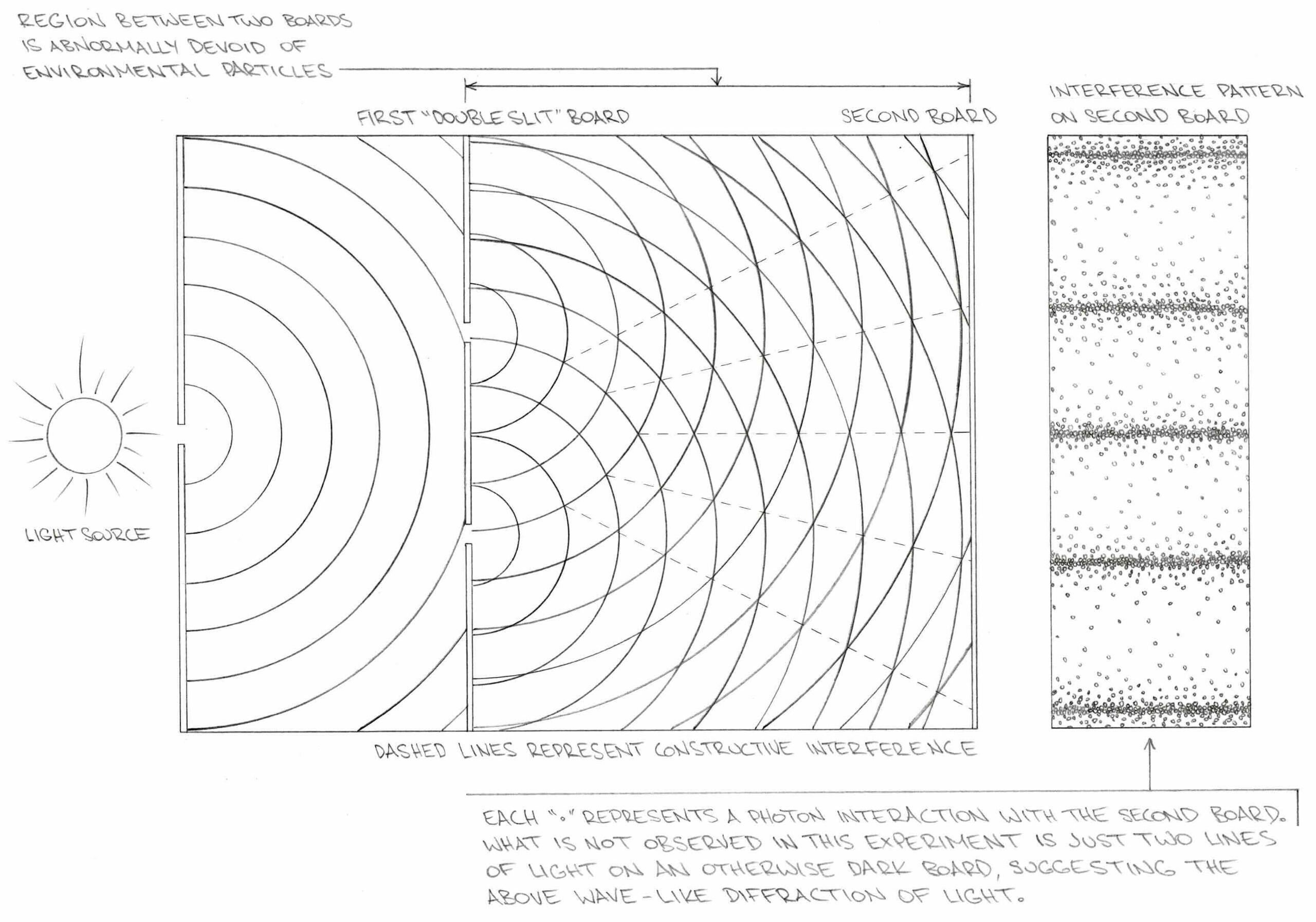
Figure 2.1: The double-slit experiment showing the wave-like diffraction of light.
The resulting series of lines that were seen, instead of just two on that second board, are what’s known as an interference pattern, where photons were distributed on that board as if they passed through the two slits as a wave of light rather than a straight-line beam. If a wave of water passes through two similar slits the resulting two sets of waves on the other side of these slits form what’s called constructive and destructive peaks and troughs. As these waves continue to travel away from these slits, where two peaks from these two wave fronts merge they constructively interact to produce a larger peak; where two troughs merge they constructively interact to produce a larger trough; and where a peak and a trough interact they destructively cancel each other out. With photons in this double-slit experiment it’s similar, although they don’t interact with each other in the way that water molecules do, they simply align themselves on the second board in a way that suggests this same distribution of enhanced peaks and troughs, or in this case, a series of lines of constructive interference between lines largely absent of particles. This is one reason why light is often referred to as a wave.
This situation has proven to be much more complicated however, and today light is most often expressed as exhibiting wave/particle duality due to the various results and interpretations achieved through small-scale particle experiments. Dissecting the head-squeezing history of these experiments, and of wave/particle duality, is not necessary for an understanding of this theory however. I believe a deeper understanding of the cause of these quirks can be more simply achieved by looking at them through the new lens of the principle of interaction.
The double-slit experiment these days, with modern manipulation of the experimental environment and apparatus can make not only photons behave in strange ways in space and time, but also electrons, atoms, and now even molecules made up of a groups of thousands of atoms. Ultimately though I would suggest that it’s the limiting of interactions of the observed object with the environment by means of darkness (a limiting of light interactions), isolating lab conditions (a limiting of air-particle interactions), and a controlled cold environment (a limiting of thermal interactions), by which these experiments can create quantum effects with ever-greater sophistication, and with ever-larger objects, which seem to defy our understanding of space and time.
Going back to the original double-slit experiment however, where we are observing the behaviour of light, why is the light appearing to travel as a wave instead of a beam, especially when I’m suggesting that no particles actually travel through space and time at all?
There are many ways of describing light today. We could describe light as a quantum particle, the photon. We could describe light as a wave. We could describe light as a disturbance in electromagnetic fields. We could describe light as electromagnetic radiation. We could describe light as an excitation in the electromagnetic field of quantum field theory. All these descriptions are correct depending on which system of understanding, or which field of physics, one is coming at this subject from, but one thing that is common to all is that all light exhibits information known as its wavelength, which is determined by the nature of its last interaction, and the kind of particle involved in that last interaction. The different colours of light that I spoke of in the former chapter, with regards to the emission spectra of atoms, could also be described as different wavelengths, which correspond to that light having different energy values, which in that earlier case I mentioned corresponds to the energy that an electron imparts to a photon of light as that electron leaps from one orbit around the nucleus of an atom to another.
A wavelength is like a signature for different kinds of light and this signature helps to determine the nature and the amount of energy provided by the photon in its subsequent interaction. As such we could see a photon’s wavelength as being information inherent to that particle. If we adjust the way we imagine particles exist in the universe in the ways suggested by this theory, we could see wavelength as being part of the information that is inherent to that photonic parcel of information that’s involved in any given interaction, with differing wavelengths representing differing relative qualities to that information, which we know from Bohr’s work on the electron corresponds to differing values of energy.
If the subsequent interaction of a photon of a given wavelength happens to be with the retina of our eyes, and if the wavelength of that light lies within the visible spectrum of all possible wavelengths, then we interpret these different wavelength signatures as different colours. But there are many wavelength signatures that exist beyond the visible spectrum, from long-wavelength radio waves and microwaves at one end, to short-wavelength X-rays and gamma rays at the other. You might have heard of many of these as being sources of radiation, and that is correct. Radio waves, microwaves, X-rays, and gamma rays are all different kinds of electromagnetic radiation; they are all different kinds of light that just happen to be invisible to our primary light-sensing organs, our eyes.
If we could see all of the light produced by natural means from the sun or from space, or produced or reflected from the world around us, I imagine we would experience a kind of visual overwhelm. If we could then, in addition, see all of the light that we humans create with our various technologies today, which now greatly outstrips all nominal natural sources of invisible radiation by many magnitudes, I imagine we would be effectively blinded by this new sea of light and the information it surrounds us in. If a photon’s wavelength is part of its information parcel then we could appreciate our new technological environments as presenting an unprecedented application of novel information on all of the cells and systems of our bodies that this light is exposed to, as well as the cells and systems that this radiative energy can penetrate to within our bodies.
But with that aside for the time being, what Thomas Young inferred as light travelling as a wave within his double-slit box — as an experimental environment that was largely devoid of ambient light — was really just particles of light interacting with the particles that made up the second board in a way that conveyed the information of their inherent wavelength, or relative energy.
What I would like to suggest is that the space between the board with the slits and the second board was so devoid of normal environmental influences that rather than appearing to travel in a straight line as a result of the coherence of information between so many particles that might otherwise be interacting in this system, these particles ended up only (or largely, as the experimental conditions in Young’s time were not as highly controlled as they are today) interacting with the particles of the second board. With so few interactions within the system of his double-slit box, which would normally provide the kind of logical information about the parameters of space and time within that box that the photons would use to determine their final, more logical, straight line destination, the photons ended up in the places that they are most likely to end up as determined by the scant information they had available to them in that system, and with so few other interactions to find themselves relative to, they used the inherent information of their wavelength to produce an interference pattern on that second board, instead of two straight lines of light directly behind the slits.
Another way to put this would be to say that with so little environmental information to create a clear and coherent picture of where they would normally interact with the second board, according to our classical understanding of cause and effect in space and time, these particles ended up in places that were more greatly determined by their own inherent information, that of their wavelength, as determined by the energy imparted to them from their previous interaction. The quality of that light’s wavelength, relative to other wavelengths, became the crucial determining factor in their final position on the second board, and became a matter of greatest probability given the various attributes of information inherent to this wavelength, instead of system-reinforced, interaction-induced, coherence of interactions, which would depict events occurring in space and time as we normally observe. We interpret wavelength as a description of a wave travelling through space and time, but what I’m suggesting is that wavelength is simply one of the informational assets of a particle of light, relative to other particles of light (photons with similar or differing wavelengths/energy), which is determined by the nature of its source (i.e., the nature of its last interaction), and need not have anything to do with assumed movement through space and time.
Now I appreciate that such a statement flies in the face of the many brilliant minds who have both experimentally and mathematically described light as an electromagnetic wave. I would suggest that this theory does nothing to diminish their findings, but instead attempts to plumb them just a little more deeply, or perhaps just differently. Unfortunately a description of electromagnetic radiation as it pertains to this theory is at this stage largely undeveloped. To do proper justice to a more thorough explanation in this regard, I would need to invest more time into a greater technical understanding of this field of physics. My suspicion however, is that the reason why light as a wave is so well demonstrated mathematically is because these equations are extensions of classical laws of motion and their inherent provisions of space and time as a fundamental reality. I suspect that underneath all of these equations lies a deeper truth about electromagnetic charge, and that without the fundamental reality of particles travelling through space and time from point A to point B, without the assumption of fundamental motion, the charged particles that we see as producing electric fields, and the movement of charged particles that produce magnetic fields, are simply two relativistic descriptions of the same thing, charge as part of the informational description of particles in interaction with each other, describing itself as inherently electric or magnetic, depending on which other interactions within the system it is being considered relative to.
So this is my initial challenge to quantum theory and its inherent weirdness. I do not challenge that what is observed in quantum experiments is not obviously weird (and there are many other experiments that push the boundaries of this weirdness much further), but I would like to challenge that this weirdness is reflective of a fundamental reality that is inherently wave-like and probabilistic; I do not expect this will ever be irrefutably demonstrated.
It’s true that what we see in the double-slit experiment is positions of photon interactions being determined by greatest probability based on their wavelength, and this has been an exceptionally fruitful way of understanding the atomic realm, but this only occurs in the vastly altered environmental conditions of these experimental setups, or alternatively, in incredibly precise technological applications (which similarly require limited environmental conditions), as well as through mathematical interpretation that presumes fundamental motion. We do not experience ourselves existing in probabilistic positions in our everyday reality because there are simply too many interactions taking place around and within us every moment of every second of every day, which provide the particles and parcelites that make up our bodies with all of the information they need to not only reinforce their own relative positions for themselves, but also for all other parcelites within their immediate systems of interaction. And as these systems of interaction are themselves in interaction with other systems of interaction, which are reinforced by the parcelites of their own systems, complete informational coherence about relative positioning of all parcelites that make up any one human, or any system consisting of us, is easily achieved, thereby rendering any notion of probabilistic positioning obsolete.
The idea that at our macroscopic human scales probabilistic positioning becomes an obsolete notion is a view well appreciated by physicists already, although instead of being thought of as the result of coherence of particle information through systems of relativistic, self-reinforcing interactions, it is instead described as the decoherence of the wave function of elementary particles (a mathematical description of particles), as a result of increased particle interactions. Without going into this in detail, the key difference between the usage of these words here is that with this idea of the decoherence of the wave function, or alternatively the “collapse” of the wave function, being that which results in the realities of cause and effect that we are accustomed to, the probabilistic wave nature of particles as derived from quantum mechanics is still assumed to be fundamental, rather than simply what is observed in specifically altered conditions.*
*[It is at this point that I think I should apologise for my use of the word “coherence,” which has a specific meaning to physicists, and for using it in a way that has a closer association for physicists to what is instead described as “decoherence.” I have always loved the meanings and associations of this word, that being: “the quality of being logical and consistent”; and “the quality of forming a unified whole,” as a way of describing the informational agreement of these particle systems. That this agreement and consistency is what allows them to fundamentally not require the parameters of space and time, the word “coherence” has seemed apt to me. But in the interests of being as clear as possible to the physics community (should I be lucky enough to be graced with their attention), and hopefully to invoke their ire as little as possible, I feel I should adjust my terminology here, and in fact it might actually be for the better. And I apologise for involving you, Dear Readers, in this process, but I do feel that the process has been revealing in its own way.
A word that perhaps more closely invokes this sense of relational agreement is “consonance,” meaning: “Harmony or agreement among components.” Also, relating to music it has the added meaning of “A combination of notes which are in harmony with each other due to the relationship between their frequencies.” Interestingly there is an inherent dichotomy in this musical definition with the idea of dissonance, which describes the lack of harmony, or in the non-musical sense of the word, a lack of agreement. I will return to the idea of dissonance shortly as I feel this idea too is relevant, but for the time being we shall carry on with our new word consonance, as it relates to these particle systems, instead of coherence.]
Probabilistic outcomes are not the only weirdness that emerges from quantum theory. Both non-local interaction, and retro-causal interaction are also evidenced by various experiments, showing that particles appear to demonstrate unusual connections to each other across unexplainable expanses of space and time. I do not wish to go into these various experiments here, as they are quite detailed and counter-intuitive and require a lot of mental stamina. They are also the result of the tireless and remarkable insights and efforts of others and I would encourage anyone not already familiar with many of these experiments to delve into them for yourself, but I would very much like to address you, and request the presence of your mental stamina with my own ideas here first. I will say this though, based on all of the experiments I’ve personally looked at, I’m not convinced that any of these cannot be more easily explained, or at least dealt a serious challenge, by the principle of interaction and the logic that I suggest extends from this principle — keeping in mind that much of this logic is yet to be explained, and with regards to non-locality and retro-causality specifically, will require a new appreciation of time. However, I’m sure many serious challenges will be dealt my way for even suggesting this, and I do welcome them, although as a punter and not a pundit I apologise in advance that it may take me some time to fully wrap my head around your arguments (if at all) and respond accordingly. I will do my best though.
So up until now it has been the presumption that quantum weirdness is somehow fundamental because it is what we see in our experiments that observe the smallest stuff of the universe, and so it has been the job of modern science to try to find a way to unify quantum mechanics (our theory that explains this apparently fundamental behaviour of the small stuff of the universe) with general relativity (our theory that quite wonderfully explains the observed behaviour of the big stuff of the universe).
What I’m suggesting is that these two theories are not in as much disagreement as we think, and that we simply need to recognise that the way that we create a means to observe the smallest stuff of the universe necessarily limits the interactions to which that stuff is exposed, and therefore encourages that stuff to behave in ways that seem to defy our own experience of space and time.
And I say our own experience of space and time here because for the photon, the electron, the atom, and even the collection of atoms that make up these experimental quantum objects, from their own point of view they are carrying on in the universe as per usual, regardless of our experimental constraints. In one moment they are interacting with a form of matter or energy, and then immediately they are interacting with another form of matter or energy. Whether the system in which they are engaged is composed of many interacting particles like in our day-to-day environments, or very few interacting particles like in the experimental setups created for quantum observations, for the particles themselves it makes no difference as they are still simply engaged in one interaction after another, with, I would argue, no travelling taking place between; sharing their information in ways determined by the standard model or something very much like it.
And here we find our next surprising revelation derived from the principle of interaction. If particles are no longer travelling from one interaction to another through space and time, then all that exists for those particles is interaction. The idea of time becomes largely irrelevant if we consider how the universe might appear from these particles’ points of view. But what might this mean as a fundamental description of our universe?
This is actually a notion that is already familiar to physicists and is once again related to the nature and behaviour of these truly wonderful particles of light known as photons, because it is already theoretically acknowledged that a particle of light, travelling at the speed of light, may not experience for itself any passing of time, nor movement through space.
As mentioned earlier this is only theoretically acknowledged and cannot be mathematically defined by special relativity, because the framework of special relativity actually demands that photons must always be considered as moving at the speed of light, to all observers, therefore making any conceptualisation of a photon “at rest from its own point of view” mathematically nonsensical. But if instead we were to consider not a photon but something else, for instance a person, travelling at the speed of light and at rest at this speed from their own point of view (which to be clear that for anything but massless objects themselves is likely impossible), then special relativity suggests that this person would experience no passing of time relative to a stationary observer, and that the space this person passed through would be done so at such a high speed that it would seem instantaneous to that person. In short this person would not experience any movement through space, nor passing of time, while travelling at the speed of light. Therefore, theoretically at least, if we could consider the experience of a photon from its own point of view, whilst accepting that we would need to modify our understanding of special relativity to legitimately do so, the suggestion would be that a photon does not experience space or time either. Without any experience of time, each new interaction does occur instantaneously/simultaneously for the photon.
The first time I considered this, and really thought about it, I was completely taken aback. I remember thinking about it intently for many days in fact, and as already mentioned it was part of the original self-reflection that has now evolved into this theory. For the photon, the fundamental experience of the universe is likely of one interaction with a particle occurring simultaneously/instantly after the last interaction with another particle. Despite the apparent distance that photon may travel between its two interactions from our point of view, which could potentially be the expanse of our entire universe — at minimum, 93 billion light years — the suggestion of special relativity (if not its concrete pronouncement) regarding the potential experience of this photon, is that its interactions could be nonetheless instantaneous. One instantaneous interaction after another… How would that translate into that photon’s experience? For an elementary particle what are these human concepts of space and time if they are not, indeed cannot be, that which exists between interaction events?
Again, from our own point of view, if the photon is not in interaction with something can it really be said to exist? Does it really exist in that space? How do we prove it? We can put a measuring device along the path of that photon’s proposed travel, but would that prove that it travelled, that it existed in the space between its last interaction and our measuring device? It does not. As mentioned already, the notion of travel is an assumption on our part, and it fails to take into account the experience of the photon and whether this unique experience might be just as relevant, and perhaps just as important as an explanation of reality as our own.
We could invoke Occam’s razor here and suggest that the simplest explanation is likely to be the most correct in order to defend the notion of the photon travelling through space, but it seems to me the idea of particles travelling through space has a hard time providing simple explanations for what happens when a supposedly single particle travels into a system that is devoid of other particles, as we see in our quantum experiments. It is as if we need to extend the principle of Occam’s razor beyond human interpretation, and ask: “What is the simplest explanation from the point of view of the photon itself?” If we were forced to choose the most relevant experience to the behaviour of subatomic particles, does it really make sense to favour our human experience over that of the subatomic particle itself?
I like to think of that little thought as my equivalent to Einstein’s imaginings of riding his bike beside a beam of light, and it is interesting to me that despite this conceptualisation of a photon’s unique experience of the universe, we insist on asserting that our human experience of travelling through space and time is the experience that best aligns with fundamental reality. I realise that much of modern physics can be tied up very neatly, and I must admit in many instances quite beautifully, with our assumption of motion and of space and time as being fundamental, but then again, after more than one-hundred years of not being able to reconcile relativity with quantum mechanics why are we still not questioning these neat assumptions? Perhaps it’s time to consider the photon’s experience of the universe more deeply? Is there an equally valid relativistic perspective for the photon that we need, in order to modify the postulates of special relativity? How might it be possible to consider a photon at rest? Perhaps it is time to take our own human experience out of the centre of the universe in a similar way that Nicolaus Copernicus once suggested we do with the Earth.
If we were to instead consider the possibility that no elementary particles fundamentally move anywhere, that fundamentally they only ever exist in a state of interaction with other particles, then the idea of an experience of space or time must arise from something else, and perhaps the notion of space and time for elementary particles is ultimately unhelpful, even leading us to unnecessarily confusing interpretations of the nature of the universe at large. But what might this experience of space and time arise from if not fundamental conditions?
If we again shift our perspective from our own experience of the universe to that of these particles, if we think about the experience of these particles from their own point of view, what could be the nature of their interactions with each other? Well, again, the interactions represent new information. They represent change. And if a particle cannot exist in the absence of another particle, if a particle can only exist when in interaction, this interaction of two particles represents one set of information, or perhaps one set of values of self as described by the shared values of one particle paired with another particle, in contrast to the previous set of values of self when that particle, that share of information, was paired with a previous particle, or a previous share of information. This is in essence a relative, elementary definition of self, of I am, of consciousness.
If interaction is the fundamental state of information/matter, then I believe that the sharing of information to create a relative definition of self is the fundamental purpose of this fundamental state of information/matter. From one interaction to the next, there is nothing else but this creation of self, where the self is defined as the coming together of information from two former selves, and whose informational parts cannot be understood to exist independent of interaction.
There is never just one parcel of information, one particle drifting alone through space and time. According to this theory space and time as we have come to understand them can only be defined by a community, if you will, of consonant particles; a community that is inherently in agreement with each other, even when to an external observer there seem to be states that suggest the opposite, or at least defy our understanding, such as those presented to us by quantum systems.
Our inability to understand the order that perhaps fundamentally exists at these foundational levels of reality could be the result of our human experience alone, because I would argue there is no discrepancy, no dissonance for the fundamental particles themselves. And for myself, this is the interesting relevance of this word dissonance, in contrast to consonance, as terms that might help us to describe particle systems. It is the idea that at the subatomic foundations of the universe there might be no such thing as dissonance, despite its apparent presentation, and that there is instead a more fundamentally abiding cosmic consonance; philosophically suggestive to me of a deeper sense of place and purpose. Of course this is perhaps far too enthusiastic a claim to make at this stage and likely reveals my own personal beliefs more than anything else, but I must admit I don’t mind trying to inject a more positive sense of purpose back into a field of physics and philosophy that seems so broadly rapt by randomness.
As with notions of fundamentally random and probabilistic realities, so too, I do not believe in fundamentally vibrational expressions of the universe, as is also suggested by certain theories and ideologies. I feel this does not dig deep enough. I don’t deny that an underlying state of vibration exists, but I see this as a frequency of interactions between many parcelites within particle systems, and that interactions within systems, within systems, within systems, can create different combinations of frequencies that are generally harmonious to each other, or discordant. Primary to even this I believe, is the interaction between two elementary particles, two elementary parcels of information, and the relative dualistic self, the parcelite, that is represented by that exchange of information from former interactions.
At the risk of sounding overly poetic, I like to think of this fundamental state of information or matter, this parcelite, as a quantum kiss, and perhaps the poetry of it is somewhat lessened by the fact that the particles — the information — involved in these exchanges then immediately (and I really do mean immediately) engage in their next quantum kiss, and their next, and their next. But the idea that the universe is fundamentally defined through relationships, that what we understand as matter and reality cannot exist outside of a state of relationship and sharing, is still rather lovely don’t you think?
~
Last Track | Track List | Next Track
— Track 3 —
Time and Its Flows
“For those of us who believe in physics, the distinction between past, present, and future is only a stubbornly persistent illusion.”
~ Albert Einstein, 1955
There is a puzzle in physics that is described by the inconsistency between our own human experience of time, and that of the subatomic particles. For us it is very apparent that time can only move in one direction, but this appears to not be the case for subatomic particles. It is possible, and currently must be allowed for within probabilistic equations, for particles to move backward in time, that is, for particles to be part of an interaction in our future, which creates an effect on particles in the present or our past. I should stress at this point that it’s possible that this is a purely mathematical behaviour, meaning it’s possible that particles do not actually move backward in time, but whether this is an actual or mathematical reverse-time-flow causality, physicists have not been able to concretely explain what they see. Additionally, when we look at elementary exchanges closely enough what we see are interactions that could be run forward or backward in either time direction without looking any different, without upsetting any laws of physics. These interactions in short, could take place from past to present, or future to present, without creating even the slightest controversy.
It is at this point that most science communicators begin talking about eggs, because in the reality of the universe that we humans and our eggs inhabit (not our eggs of course, but hopefully our well-cared-for-backyard-poultry-bird’s eggs) this ambidextrous time directionality does not exist. If we drop one of our well-cared-for-backyard-poultry-bird’s eggs onto the ground we will watch it crack, and smash, and impressively distribute its contents onto the floor. From the past moment of the egg being whole, to the present moment of the egg being a big mess on the floor, there was a common-sense directionality of the laws of physics that dictated this intuitively well-understood process. But at the scale of all of the subatomic particles involved in this egg smashing process, we could watch the trillions upon trillions of interactions that describe it and we would see no such obvious directionality. These subatomic exchanges of information could happen in either time direction and viewing it at that scale at least, we would have no idea if we were watching the process in a forward-time-flow direction, or a backward-time-flow direction.
Even at larger scales, the laws of classical physics could move in either time direction too. The physics and mathematics involved in the egg moving upwards from the floor to our hand makes just as much sense in this reverse time direction as it does in our forward time direction. The energy that is dispersed outward in the explosion of the egg upon the floor is perfectly sufficient, if the time-flow direction were to be reversed, to propel the egg back up off the floor into our hand, but intuitively it makes no sense to us for an egg to be able to reform itself from smashed and dispersed, to whole and contained. This, I suggest, is a limitation of our own human appreciation of the universe and nothing more. To be more specific I should say our experience as forward-time-flow-direction beings, because this experience is not limited to humanity; it is shared by all dominant life forms on Earth (and in my mind, likely, all similarly evolved potential life forms in this region and in this era of the universe).
The reason why it is shared by all dominant life forms on Earth is, I would posit, because all life forms here have evolved to make the most of the universe’s entropy. What is entropy? Unfortunately there is no straight forward and completely accurate answer to this question, without getting slightly technical, but for our more general purposes here we could somewhat incompletely describe entropy as our observation that the matter and energy of the universe tends to expand from smaller, simpler, more ordered states, into larger, more complicated, and more disordered states. Think of a solid granite boulder slowly being weathered down by the elements, and all of its constituent atoms slowly dispersing, in all manner of ways, into the broader environment. Or, if you imagine that according to the big bang theory we can theoretically trace all of the universe, all the matter and energy that makes up everything that we know, to have been contained in an area of space about 1.5 metres wide, but since then the universe has expanded to an unimaginably large size, with equally unimaginable complexity compared to this original state, and the likely fact that it, and everything in it, is still expanding and becoming even more complex and disordered, then this hopefully at least gives you an intuitive sense of this concept that is described as entropy.*
*[As a brief aside, I am simultaneously fascinated and somewhat weirded out by the thought that this currently theorised minimum bound of the universe of about 1.5 metres, is also considered to be the approximate height of Australopithecus afarensis, our earliest known hominid ancestor, made famous by the discovery of “Lucy.” I know this must seem like a ridiculous correlation to make, and I don’t necessarily disagree, but of all the possible relative sizes that our universal “egg” may have been, for me at least, it’s a rather entertaining coincidence.]
It is assumed that entropy is part of the puzzle of the directionality of time, and annoyingly, like a zen monk, I would suggest that this is both correct and incorrect according to this theory. It is certainly part of the puzzle of the directionality of the interaction of organisations of matter and energy in the universe, but in my opinion this has nothing to do with any concrete notion or description of time’s directionality. Time, in my opinion, must always be a relative concept.
We humans have the tendency to tie this quality of entropy, of increasing disorder and complexity, inexplicably with the forward direction of time that we experience, but just like the temporally ambidextrous particle interactions illustrated at more elementary levels of reality by an egg smashing on the floor, I believe that it is equally fair to say that if we humans were to view the universe moving in a reverse time direction, we would see an equally reasonable reverse entropic process, a “structropic” process if you like (from the greek roots struct, meaning “to build,” and tropy, from trópos, meaning “turn” or “change”), whereby we would see a tendency for all matter to “build” (very counter-intuitively mind you) towards increasing order and simplicity. The reason we don’t see this is because in this region and era of the universe, to be a life form that might have evolved to make use of increasing structropy, that is, matter becoming more ordered and simplified, would be an evolutionary dead end.
I like to think of it this way: if I were a single-celled organism swimming in some primeval soup, but I had evolved to interact with matter in the backward-time-flow direction (which is something I will later elaborate on as a theoretical possibility), then I would be attempting to exploit energy from a system whose material complexity was becoming simpler, not greater. If I were on my own with no competition then perhaps I could eke out an existence in this way for the full duration of my lifetime, but if I were sharing this primeval soup with others like me, then eventually we would all be competing for more and more concentrated energy resources. With matter around us becoming more concentrated and simplified in this backward time direction, due to the universe’s natural general contraction back towards the moment of the big bang, it would become increasingly difficult to exploit the matter around us to use as energy for survival (at least in the ways that we are familiar with for the life forms we have so far observed). It would certainly not be an existence conducive to producing offspring, who, as an expanding population in this backward time flow, would make already decreasing material resources even more scarce, more quickly. If on the other hand, I were a single-celled organism swimming in this primeval soup who had evolved to interact with matter in our more intuitive forward-time-flow direction, then I would be exploiting energy from a system whose material complexity was becoming greater, not simpler. My potential offspring and I would be at an immediate advantage compared to our backward-time-flow-evolved competitors.
I actually imagine this to have been a realistic scenario in Earth’s primeval creches. Many little single-celled experiments (or otherwise, as who knows the full extent of nature’s experimentation) in the utilisation of both increasing and decreasing matter and energy (experiments with the utilisation of we we might describe as the forward moving entropy, and backward moving structropy, but which are one and the same process as viewed from different time-flow vantage points), with the processes of evolution and natural selection determining which way of interacting with this changing distribution of matter and energy was the most conducive for life, or at least life as we know it.
Perhaps there were other kinds of life, experimenting with matter and energy in different ways, with or without a sense of time flow? Who knows? Perhaps their ancestors have survived too but they exist in a state that we simply have not evolved to interact with? It is humbling for me to think that our understanding of time and of entropy might be but one of many ways of interacting with the matter and energy of the universe at large, and that behind the reality that evolution and natural selection has crafted for our benefit and survival, within the ecosystems that we can readily perceive and interact with, there may be alternative realities, alternative ways of interacting with matter and energy, alternative ecosystems, and alternative ways of interacting with what we call time, crafted for the survival of different beings/manifestations of matter and energy that perhaps exist alongside our own perceived reality. Or perhaps that’s just my love of science fiction getting the better of me?
But how could it be possible for a single-celled organism to evolve to interpret reality with a backward-time-flow direction to begin with? We know that the laws of physics work equally well both forward and backward through time. The fundamental expression of information/matter in the universe that I propose, through the principle of interaction, is also equally capable of representing both a forward- and a backward-time-flow direction. But let’s place ourselves in the shoes of these elementary particles again, who just to reiterate can never exist in isolation, only as a dualistic pair, and explore what reality might be like for them.
I’ve mentioned before that in interaction with each other they share information of a nature that distinguishes current dualistic self (self with newly paired information resulting from current particle interaction) with a former dualistic self (self with former paired information resulting from a former particle interaction). This, in essence, could be thought of as a form of consciousness. It’s a distinction of information about current self relative to information about self from a former interaction. From the perspective of the dualistic particle, one might say that the information that defines my (dualistic) state in this moment, is different from the information that defined my (dualistic) state in the last moment. I believe this gives us a unit of consciousness, a quanta of consciousness; an awareness of self possible only through a dualistic state (a state of interaction with another particle) and only when the information that defines this dualistic state is compared to a former dualistic state.
To illustrate a little more clearly what I mean here, let’s for a moment pretend that there are such things as apple particles and plum particles — little sub-atomic particles that look like, and carry the information of, apple particles and plum particles. If I am a particular type of apple particle, a red apple particle, is there any way that I know that I’m a red apple particle, and not a green apple particle, or even a whole other kind of particle, such as a plum particle? Well if I spend all of my time in interaction with other particles (from my own subatomic particle point of view, according to this theory), then I’m never just a red apple particle, I’m a red apple particle interacting with other red apple particles, green apple particles, or plum particles. When I’m interacting with another red apple particle, and then my next interaction is with a green apple particle, I expect I could tell there is a difference between the two sets of information that these two interaction events hold. Red apple paired with red apple holds a different set of information to red apple paired with green apple. Furthermore, when I interact with a red or green apple particle, and then interact with a plum particle, I expect that I could tell there is even more of a difference between the information shared. After these interactions I have a sense that the information that remains consistent through all these interactions is that which I define as a red apple. Therefore I must be a red apple. I am a red apple even though I never experience anything outside of interaction with other apples and plums. This is my sense of self. This is my awareness of what defines me. And who knows, there may even be slight informational differences between red apple interactions within different overall circumstances or systems of interactions, which might give me a sense of self as unique among other red apples…
What I think we have here is a fundamental consciousness, a quantum or elementary consciousness, that is defined by the informational assets of elementary particles as relative to other particles, when interacting with them and sharing information. Just to clarify though, this is not consciousness in the sense of the thought-oriented awareness that we humans normally ascribe to such a word, it’s instead an informational definition achieved through a state of interaction that only makes sense when it is considered relative to other interactions. Any underlying meaning or utility for this information, this definition, this consciousness, is only relevant for particles in interaction, or more likely, to the broader systems that these particles find themselves interacting within. However, what I find particularly exciting about this notion of quantum consciousness is that from it I believe a fundamental notion of time naturally emerges.
I’ve already mentioned how I believe the overall consonance of information shared by and amongst particles in any given system helps to define the parameters of space and time within that system, with no underlying “fabric of spacetime” being necessary, and how limiting the interactions of particles within systems is what, in my opinion, is responsible for so much of the quantum weirdness that has been observed. Well, a key element to understanding this view is imagining how this elementary consciousness might be created, through dualistic particles (parcelites) defining themselves relative to other dualistic particles, and in doing so naturally creating the relativistic framework of time that Einstein so cleverly envisioned with his theory of special relativity (more on this later). If all that exists for elementary particles is interaction with other elementary particles, with no interim between for travelling, then the information pertaining to the ordering of one interaction relative to other interactions naturally establishes the informational asset we could call “relative,” or “informational” time. This information is created in each interaction (relative to former interactions), which is then used in later interactions to help relativistically create new temporal information assets in new interactions. Among only a few particle interactions this information does not amount to much but among trillions of particle interactions within even a very small system, say a ball rolling across a table, there is enough information at an elementary level to create enough informational “bits” of time that at larger scales could informationally resolve into a smooth and consistent relative ordering of cause and effect — what we interpret as time.
We could say the same about space also. For the particles moving from one instantaneous interaction to another there can be no notion of absolute space for them either. Space too must be a relative informational asset. According to this theory it only emerges as the consonance of information of all the particles within the system interacting with each other in ways defined by fundamental parameters, like those of our standard model, which in turn informationally defines something that to us time-and-space-perceiving beings results in the spatial parameters of that system. As with temporal information, with enough particle interactions within any given system of interacting particles there are enough bits of relative spatial information to consonantly resolve all of that information into a “space,” a system where all of those interactions can be logically ordered, in both space and time, by a complete understanding of the vastly interconnected cause and effect relationships within that system. It is simply a process of information from interactions being consonant with all other interactions, which again to reiterate, is why quantum weirdness occurs — there is not enough information from interactions within the system for the interactions being observed to be defined as we would expect in ordinary circumstances, with ordinary particle interaction densities.
In this view, there is no information of a system that is external to the information inherent to the interacting particles that make up that system. There is no extraneous spacetime, or quantum field, or spacetime strings. As mathematically and geometrically pleasing as these theories are (and also not discounting their inherent beauty or the many valuable insights they have inspired), I believe they are more complicated than a theory of everything needs to be, or needs to include. I believe that the observations that have led us to envision spacetime, the quantum field, and string theory, might one day be explained by particle interactions and parcelites alone.
It is useful to think about the idea of fields here for a moment because it illustrates this point quite well. According to this theory there is no such thing as fields, like what we interpret as the electromagnetic field, because fundamentally there is no “space” for those fields to fill. That electromagnetism exists is not something I’m disputing, just the notion of fields of electromagnetic “energy” or “potential,” for which even now, nearly two-hundred years after their mathematical formulation, we still do not have an adequate explanation for. Despite being able to make ridiculously fine and sophisticated use of electromagnetism, often based upon our theoretical understanding of electromagnetism as fields, we still don’t know why electromagnetism appears to exist as fields or radiate at certain frequencies. In this theory there are no fields because the electrons that we envision as making up those fields do not exist in isolation. But they do interact with other surrounding particles in ways that are consistent with the idea of fields, because they carry electromagnetic information that when measured, and assumed to exist within a fundamental framework of spacetime, is most easily interpreted as “fields” of isolated particles.
Because particles do not travel between their interactions with each other or other elementary particles, there can be no amorphous field, or radiating waves, there is only the multitudes of interactions that take place within regions that are highly suggestive of these fields or waves. These regions are suggestive of fields and waves of particular placements and frequencies because the particles involved carry informational assets that we have come to define as those frequencies, which have made perfect sense within the framework that we have come to understand as spacetime, and with our presumption of fundamental motion as being an expression or action of matter and energy within that spacetime. But perhaps there are other, more nuanced ways to interpret this information? What more could we learn by trying to do so?
The interesting thing about this new appreciation of spacetime, is that at this level of elementary matter there is still no flow of time in one temporal direction or the other. While according to this theory, quantum, or elementary consciousness may be responsible for the emergence of a kind of “informational time,” where one interaction might be given a placement as an event in time relative to other interactions, in my opinion it is levels of consciousness of much greater complexity that are responsible for the emergence of the information that would suggest a flow of time — remembering that at this particle level there may be no distinction between interactions that happen from the past to the present, and those that happen from the future to the present, as our egg shattering example illustrated. The physics of both the forward- and backward-time flow are equally valid, so if we were to postulate that both time flows are occurring (or at least possible) at this elementary level, then what is it that produces our perceived forward flow of time?
If we focus on elementary particles, that is, particles that are not believed to be made up of smaller units of mass or energy, I would like to suggest that we could call this level of informational definition of self, what I’m calling a quanta of consciousness, both “elementary consciousness,” and “1st order consciousness.” According to the standard model, generally speaking this 1st order consciousness would be the result of interactions between bosons, leptons, and quarks (referring to our earlier example these would be our most elementary level of apple and plum particles). These bosons, leptons, and quarks interact in ways that form the elementary foundation of the material world that we know. They group up with each other as units of information/matter to form a higher level of material order. With 1st order consciousness I would like to suggest that there is a relative frequency of interaction among particles within a given system that is explicit to that order, when considered relative to another order of consciousness within that same system. It could perhaps be described by the average number of interactions that take place among 1st order consciousness particles within a given system, within a given time-frame, relative to the average number of interactions that take place among groups of 1st order consciousness particles within that system. The higher frequency of interaction among 1st order consciousness particles when compared to the relatively lower frequency of interaction among groups of 1st order consciousness particles is what I suggest could denote that next order of consciousness — 2nd order consciousness. At this next level, 2nd order consciousness now deals with a sense of self that is derived from groups of these particles interacting with each other, and at this level too we can think of these groups of particles, and the elementary structures they form, as being our next level of apples and plums, where a sense of self — or “what am I/what group am I?” — is derived from relative comparison with other groups and the different shades of information shared and relevant to those groups.
I propose that we could use this method of generally ordering levels of consciousness to create a hierarchy of consciousness all the way up to our human-mind level, what I like to think of as our “cardinal consciousness,” and well beyond this also, where at each level a sense of self-definition, a sense of “What am I?” is achieved through interaction and comparison with their surrounding environment.
~
Just to clarify my terms terms being used:
Fundamental Consciousness: A definition of self, of I am, derived from an awareness of information about that self in a state of current interaction, which inherently includes information about other interactions and is therefore fundamentally relativistic.
Elementary Consciousness: Dealing with elementary particles that cannot be seen to be made up of smaller particles/parcels of information, elementary consciousness relates to the most primal and simple form of fundamental consciousness. Elementary consciousness can also be described as 1st order consciousness. When you consider that according to this theory elementary particles are necessarily always in interaction with other particles as a combined parcelite unit, another way of thinking of a parcelite is as a unit of elementary consciousness.
Quantum Consciousness: Dealing with both elementary particles, and groups of elementary particles known to be affected by quantum mechanical effects. Quantum consciousness is a more general term relating to fundamental consciousness at the various and subtle subatomic levels.
Orders of Consciousness: A way of describing differing levels of fundamental consciousness as generally based on the relative frequency of interactions.
Lower Orders of Consciousness: Levels of fundamental consciousness that have within them a higher frequency of interaction amongst selves of this order, relative to the frequency of interactions among other selves in other orders.
Higher Orders of Consciousness: Levels of fundamental consciousness that have within them a lower frequency of interaction amongst selves of this order, relative to the frequency of interactions among other selves in other orders.*
*[I appreciate that at the language level, “lower orders of consciousness” relating to higher relative frequencies of interaction, and “higher orders of consciousness” relating to lower relative frequencies of interaction, might seem counter-productive, but I feel that when you consider that these orders of consciousness ultimately arrange into what we know as the lower and higher life forms, and the simpler and more complex material forms, the formalism I’m suggesting, seems to me, to make more sense.]
Hierarchy of Consciousness: Beginning with 1st order consciousness and with no clearly known or possibly definable upper limit, a hierarchy of consciousness is a way to generally order relative levels of fundamental consciousness based on the frequency of interactions within those orders.
Cardinal Consciousness: The level of fundamental consciousness that is experienced by we human beings and to which we ascribe our sense of self.*
*[Here specifically I feel, we see the usefulness of the term “fundamental consciousness” to distinguish between this description of consciousness (this cardinal consciousness), and consciousness as defined by social and cognitive fields of enquiry, which could generally be described as self-awareness achieved by cognitive function, that while perhaps not exclusive to humans, is certainly experienced quite distinctly by us. With these new terms we can define our own sense of self as both our “cardinal consciousness,” which is akin to current definitions of consciousness, but also as the “fundamental consciousness” that operates at our human level of interaction with our environment. But we can simultaneously discuss the fundamental consciousness of other systems or structures that operate within our bodies, within the world around us, or all the way down to groups of particles or subatomic particles themselves, and without being in conflict with ideas of cognition or the self-awareness that seems specific to the levels of consciousness typically occupied by complex life forms.
We can even begin to contemplate strata of consciousness “above” our cardinal consciousness, and what manifestation this might take, or what philosophical, or dare I say, theological, meaning this kind of consciousness might represent. We could perhaps draw a scientifically inaccurate but thought provoking analogy to a human gut bacterium contemplating the presence of levels of consciousness and coordinating order that might exist above and beyond themselves; and chiefly relevant to us, whether they could contemplate that they exist inside a human being and as part of an organised human consciousness? I describe this as scientifically inaccurate because these bacteria do not have the cognition apparatus that we do, which enables this kind of self-reflection, but then one could counter by asking if there might be levels of conscious awareness that exist in higher strata of consciousness to ourselves, which by their very nature are as physically incompatible with our way of operating in the universe as our human sense of self might be compared to those of our gut bacteria? Personally, I find these new consciousness horizons incredibly thought provoking.]
~
From the various orders of the subatomic quantum consciousness states, we could hypothetically envision orders of atomic consciousness, then molecular consciousness, then cellular consciousness, then organ consciousness, then body consciousness, culminating in the human-being level of cardinal consciousness, which in my opinion would be the result of the interactive totality of all of the orders of consciousness that enable the human organism to function (whether we are aware of these orders of consciousness or not). Obviously there would be a vast array of sub-orders within all of these levels of consciousness just stated, and likely no order strictly being able to define any particular level because of the subtleties of the interplay between the structures within the levels themselves, but it may prove useful to approximate these orders, or something like them, for the time being. And while I suspect it might be theoretically possible to devise a more functional mathematical description of these orders based on the relative frequency of interactions between structures that might informationally define themselves as “self” compared to others, at this stage it’s really just a convenient and general way to grapple with a theory of relative levels of fundamental consciousness.
When looking at time-flow direction from the new perspective of orders of consciousness however, we find some interesting possibilities. For instance if we consider that the order of consciousness that might be applicable to single-celled organisms, we could imagine this as being all of the particles, atoms, and molecules within that single-cell forming a totality of structural and informational complexity that allows that cell to have a sense of self distinct from the environment it exists in, and interacts with. Even in the absence of another similarly-sized cell to interact with, this cell is able to define itself as distinct from its environment through the constructive consciousness of its smaller forms and structures that exist internally and in its cell walls, and which take in and interact with smaller particles from the outside. Through these smaller forms and structures within itself, and their own sense of self as defined by their own order of consciousness, there is still an interaction with the environment that helps the overall cell define itself as distinct from that environment, from one moment to the next. This would be akin to our own ability to define ourselves as separate from the air around us, partly because of the smaller sense organs in our skin, which help us recognise the movement of air around us as novel, and not a part of our own bodily functions (tempted to deploy a fart joke here, but I will refrain).
So at this level, the cell’s sense of self is largely defined by the interaction of its smaller forms and structures, which help it detect external matter or energy, and much like as occurs at the particle level, this interaction is providing these structures and the cell at large with a sense of self relative to a former interaction. But if we consider for a moment that it’s equally valid for time to be flowing in both time-flow directions according to the laws of physics, then the particles that make up these cells and cellular structures should, in theory at least, be able to receive information from both time-flow directions, should they not? How then, do these cellular structures know what is past interaction and what is future interaction? What I would like to suggest is that at the order of consciousness of the cell, or more likely at some point between the orders of consciousness of the molecule and the cell, there became apparent an evolutionary advantage to exploiting the flow of time in one direction, or the other. The evolutionary advantage I’m speaking of is the ability to learn from past events.
A single-celled organism that is able to have some rudimentary ability to define itself relative to one time-flow past or the other (that is, a time-flow past that is in the past relative to us, or a time-flow past that is in the future relative to us), has the ability to compare its current circumstances to its former circumstances, which gives it an evolutionary edge in its ability to exploit available resources. For example, if this single-celled organism is able to compare its current position, which might have reduced access to consumable resources, with a former position, which had greater access to resources, then by way of comparison it has a greater chance of being able to locate itself within a resource-rich region than a single-celled organism which does not have this ability.
How the single-celled organism developed this ability is a question I will have to leave for others, but intuitively it makes sense to me for it to have come about between the orders of consciousness of the molecule and the cell, and I’m also guessing it’s the result of quite an elegant interplay of interactions taking place both within and around the cellular structures of the organism.
Regardless of how they might have developed this ability, I do imagine that when this evolutionary adaptation was first being utilised there may have been single-celled organisms evolving to exploit resources in both a forward-time-flow direction, as well as a backward-time-flow direction, but as mentioned earlier, due to the universe’s natural expansion of matter and energy in what we call the forward-time-flow direction in this region and era in the universe’s history, those organisms that evolved to exploit resources in the forward-time-flow direction had the evolutionary upper hand, and eventually outcompeted the backward-time-flow organisms in a manner similar to what I have already described.
I do like to imagine however, that there could still be very basic organisms experimenting with this trait in quiet little creches on this planet somewhere, and if we were to look at them more closely with this theory in mind, perhaps we might be able to see for ourselves little single-celled examples of life living in reverse?
So we’ve already covered that a kind of informational time emerges naturally as a result of elementary consciousness. This is information that emerges naturally as the temporal parameters of a system based on nothing more than the information inherent to interactions within that system, relative to each other. Now I’m suggesting that time flow is an evolutionary adaptation specific to life as we know it, bearing in mind that perhaps it manifests in other ways in this universe also. However, both descriptions of time emerge quite naturally from the principle of interaction and the definition of self as a result of this principle. Elementary consciousness is responsible for the existence of “informational time” — a more purely relativistic concept of time or the ordering of interactions — while a more refined sense of self, a more refined consciousness, in what we are able to observe as typically denoting “life” here on Earth, is responsible for what we might understand as “time flow.”
The next notion to consider is that if time flow is something that emerges directly from organisations of matter that have evolved a capacity for memory, or temporal self-comparison, is it possible that the rate at which time flows for different life forms (or self-comparing organisations of matter) might also be something that is tuned by evolution, and may therefore be different for different beings? In other words, is the rate at which time flows for different beings an evolved trait? This has always been a question of interest for me, perhaps first aroused by watching the incredibly fast movements of birds and insects in the garden. It has always just seemed so unlikely to me that they would share the same pace of time’s unfolding as we humans.
Using elementary consciousness as the new starting block for probing questions like this, could it be that the perceived rate at which time flows for any life-based consciousness is determined by the frequency with which that consciousness interacts with, and compares itself to, the world around it? In other words, the same frequency of interaction metric that I suggested could be used to help define orders of consciousness, could also be used at the scale of conscious organisms to establish a general rate at which time flows for those organisms, which I imagine is then also fine tuned through evolutionary and natural-selection processes.
The rate at which an organism engages, interacts with, and responds to changes in the environment will determine the conscious attention of that organism. Even if there is no neural sense of self, a more primal sense of self and a more primal consciousness can still be determined by the structures within that organism that allow it to compare itself with the environment at large. If an organism exists in an environment where it is subject to a high rate of interactions with external influences, then I suggest natural selection would confer survival advantage to those organisms whose innate structures, internal processes, and external responses, allow them to engage efficiently with this high rate of interaction. Those organisms whose innate structures, internal processes, and external responses, have trouble “keeping up” with this high rate of interaction will be less successful in passing on their traits to subsequent generations. Because an organism’s ability to engage with its environment at a higher rate is determined by the rate of engagement of its innate structures, internal processes, and external responses, this higher response rate would suggest that these innate processes need to work faster, which will demand more energy and thus either a greater or more efficient exploitation of available energy resources. So I imagine that with the aid of natural selection, an organism’s rate of engagement with its environment is constantly fine-tuned to find the balance between the rate that provides the greatest survival advantage, and the rate that demands the least energy.
With this in mind I’d like to suggest that the rate of time flow for a fly is necessarily of a higher rate of engagement with its environment than the rate of time flow for us humans. This is why it’s so hard to swat them with your hand (unless you’re Mr Miyagi). Flies have evolved to interact with the survival conditions relevant to them. They have to be able to evade other small and fast moving predators, and I imagine they also have to be able to adapt to the quickly changing micro-currents in the air that would greatly affect their lightweight bodies and their ability to fly to where they need to go. Compared to the speeds of survival influences like these, our relatively massive, and slow-moving hands should be (and through much personal experience are) quite easy for a fly to evade. Similarly I often marvel at the aerial manoeuvres of willy wagtails (robin-like birds here in Australia) as they chase down insects, like flies, in mid-flight. It is not possible for me to imagine that they perceive the flow of time at the same rate as us because the speed of their twists and turns defy my ability to competently track them with my eyes, let alone the physical responses and critical decision making that the willy wagtail must also be employing. I cannot imagine them not having a more rapid perception of the flow of time to enable this, and if we use a theory of time-flow rate that emerges from a theory of fundamental consciousness, which itself has built into it the idea of relative interaction frequencies of different orders or levels of physical processes (e.g. the level of atoms relative to the levels of both subatomic particles as well as molecules), then relative time-flow rates for organisms that are under different evolutionary pressures seems quite natural and logical to me.
I imagine we could find examples of beings here on Earth who have a much lower rate of time-flow perception too. The ponderous and slow moving Galapagos tortoises come to mind. They have evolved no necessity to engage with stimuli from their environment at the higher rates of most other beings, and being so large and isolated on their islands, have no predatory threats that would require this of them. I suspect therefore, that they can borrow more energy from the time-flow perception/energy expenditure balance sheet that I mentioned before, and find a much more energy efficient time-flow perception that allows their bodies to expend less energy while going about their daily tasks (which means moving more slowly relative to us). One must then wonder if this energy efficiency is directly connected to their exceptionally long life spans too? If so there might be a way to measure average lifespans of a species based on metrics involving orders of consciousness; an equation for longevity, so to speak. Compare the lifespans of a fly to one of these tortoises for example.
It makes me smile to think that Galapagos tortoises, so instrumental to Darwin’s theory of evolution, may provide insights into the “evolution” of the flow of time itself.
I also suspect that there may be mechanisms innate to exceptional survival circumstances, whereby even us relatively low-rate-time-flow-perceiving humans may be able to speed up our perception of time, increasing our ability to engage with external stimuli, and effectively slowing the flow of time. I have experienced something akin to this myself.
I once got thrown off my surfboard when I was out surfing heavier waves than I’d normally go for, at a break at Tuross Head in New South Wales (and let’s be honest, “thrown off” is really another way of saying I buggered-up and got completely owned by the wave). I remember being pushed underwater so hard and fast that my eardrums popped, completely throwing off my sense of direction in the roiling water. It was in this state that I distinctly remember having a sense of everything slowing down around me and instead of feeling panicked I actually felt oddly at ease. I was aware that I needed to get to the surface but because everything around me seemed slower, and as a result so much less chaotic, I didn’t feel the urgency that this kind of situation might normally evoke. So profound was this shift in perception that despite the immediacy of the situation I remember experiencing a sense of awe in being able to feel and watch the flow and movement of water around me, to see this underwater world in a whole new way. In this state I was able to orient myself and eventually reach the surface in time to take another breath (unfortunately only just before being pushed down again by the next wave, but I’m here to tell the tale so it all worked out). When I was aware of which direction to swim to reach the surface, I remember this “slowing down of time effect” seemed to pass, and I dealt with getting myself back to the beach in a once again dazed and floundering manner, but I will never forget those serenely violent moments.
The biological mechanism that allows this temporary, whole body response to external stimuli, is again a question best left to others, but I imagine from an energy demand point of view it represents a trade of short-term higher than normal energy consumption in order to facilitate greater survival outcomes. It might be helpful to remember whether I was particularly hungry and felt sudden energy demands after I got back to shore, but sadly I have no memory of this, and any impulse I might have had to go and get a meat pie and a coffee would not have been distinguishable from my normal post-surf routine. The ethos of experimentalism eludes me once again.
~
Last Track | Track List | Next Track
— Track 4 —
Energy and Its Ticks
“Try and penetrate with our limited means the secrets of nature and you will find that, behind all the discernible concatenations, there remains something subtle, intangible, and inexplicable.”
~ Albert Einstein, 1927
It is at this point that I must digress slightly from our musings about time, but only because a full understanding of time, according to still point theory, requires a new examination of that feature of the universe which is perhaps made most clear and apparent by it, at least also according to this theory. What I’m talking about is energy.
Energy is a concept that is surprisingly difficult to pin down in physics, in a general way at least. While physicists have a very precise grasp of how energy is involved in most of the interactions that take place in our universe (those that we can currently detect, that is), and while various physical laws have been established that align with much of our observations to date, a clear — and dare I say, intuitive — definition of energy, remains elusive.
While Einstein’s above quote is suggestive of an enquiry so much broader than any single physical concept, the probing of this theory as it relates to energy often brings me back to it. He actually made this statement in response to a question of whether he, Albert Einstein, was religious — a subject that both atheists and theists alike, somewhat frustratingly could not pin him down on one way or another. That one of the most deep-thinking figures the world has ever known was reluctant to reduce his beliefs around religion to a simple yes, I believe in God, or no I do not, and the fact that this concept of energy in physics is similarly so difficult to pin down, are not, I suspect, entirely unrelated. But I’m getting a little ahead of myself there.
What I am about to share is my own intuitive explanation for energy, which I expect only scratches the surface, but as we go on, and we tease out these ideas as they relate to so many others at the root of this enquiry, I suspect we will have brought ourselves nearer to Einstein’s subtle and intangible, if still not his inexplicable — and yet, as a creative at heart I personally feel it’s best that some things remain beyond words. And if Einstein’s friend Kurt Gödel has anything to say on the matter, beyond mathematical description also.
So beginning with Einstein once again, let’s start with the world’s most famous description of energy; his, and certainly the world’s most famous equation also: E = mc².
The E of this equation is a very specific description of energy. If I’m not mistaken here it’s energy, as force multiplied by distance, with Force in turn being a measure of mass multiplied by acceleration. So ideas of motion and of spatial and temporal distances are baked into this equation already in order to give us this particular description of energy. What we measure as energy and mass here is necessarily tied to motion (or resistance to motion in the case of mass), as well as spatial and temporal distance, and so given the general bent of this theory and its reappraisal of these concepts, I find myself wondering if a deeper truth may be lying in wait. A simpler truth perhaps? The following is my logic (possibly flawed), for how the principle of interaction, and specifically the insights it provides regarding the relativistic nature of time, might give us a new appreciation of this fundamental feature of the universe.
According to this theory everything that exists is made up of interacting particles. There are never particles in isolation; or put another way, there are never particles not in interaction. Everything is made up of much smaller things that are always in a state of change; a state of informational sharing; a state of creation of something new. What I would like to suggest with this theory is that with there being no such thing as fundamental motion through space and time, with there only being interactions that take place in logical causal order, and which we humans consciously experience according to our unique time-flow perspective, what appears to be motion of macroscopic objects at our unique level of perception is instead an orchestration of particle interactions taking place at such an enormously high rate relative to our own perception, that continuous and flowing movement of these object’s constituent elementary particles seems the most obvious explanation for that perceived movement.
Science is well studded by assumptions that, despite seeming patently obvious, are ultimately revealed to be incorrect. I am suggesting the same might be true here with the concept of objects moving through space and time.
In other words, as I’ve already suggested, motion is only apparent, not fundamental. When you move your finger it seems obvious that all of the particles that make up this finger are moving in concert. It seems unnatural to think that much like the fundamental quantum leaps of electrons revealed by Neils Bohr, all of the information that makes up the elementary particles of your finger are instead being created in each new interaction event that represents the path of your finger’s movement. Again Occam’s razor might suggest that movement of particles is the simplest explanation, but again I would suggest this is only the simplest explanation to us human beings. From the standpoint of elementary particles, perhaps the idea of motion might seem unnecessarily complicated in allowing for the consonant orchestration of information creation and transfer that represents a system of particle interactions?
But let’s think about this with relation to energy, which is one of the most important features of the information that we can glean about any system of interacting particles.
It makes sense for us to think of an object that is moving, or whose system of interacting particles denotes movement — which for ease I will simply refer to as “movement” in most cases from now on — it makes sense for us to think of this moving object as being energetic. It seems intuitively obvious for us to think of this moving object as having greater energy than an object that is at rest for example, but even things that are completely at rest in their environment, even if that environment itself appears to be static and unchanging, are in fact in a constant state of change at the level of their constituent elementary particles. All macroscopic objects, either in motion relative to something else, or completely at rest, are in a state of particle information exchange not only in themselves but also with their environment, even if those environments are also at rest. We could simplistically suggest then that the difference between a moving object and an object at rest is the relatively greater amount of energy in the system of the moving object.
When thinking about this through the lens of fundamental consciousness already described, this idea of change, sharing, and creation as being the primary action of the universe — through interaction — means that to exist is to be in a state of change/sharing/creation by definition. What I would like to now suggest is that this state of change/sharing/creation achieved by interaction, when considered again relative to frequencies of interaction of other systems, is what gives rise to what we would consider as one system being more or less “energetic” relative to those other systems. As such, the energetic description of one system relative to another is more fundamentally about rates of particle interactions rather than motion or movement. Motion and movement is the apparent macroscopic description of higher rates of particle interactions, but fundamentally we’re still just talking about relative interaction rates.
I see this quality of energy as being inherently tied to frequency of interaction in the same way that I see consciousness as being inherently tied to any interaction. In fact I see fundamental consciousness, and something that could perhaps be described as fundamental energy, as being two descriptions of the same underlying concept. While fundamental consciousness, at an elementary scale at least, is effectively a description of the sense of self achieved by any interaction between two particles — a description of an elemental unit, a parcelite — which only has relevance when considered relative to other interactions, fundamental energy could be described as the exchange of information between these particles that results in this consciousness. If you like, fundamental energy is the exchange, while fundamental consciousness is the result of that exchange. Two sides of the interaction coin.
But like fundamental consciousness only being relevant when considered relative to other interactions, any broader emergent description of the energy of a system of particles can also only be evaluated relative to other interactions; as rates of interactions, rates of exchanges of information, relative to other particle and exchange rates within that system, or to which that system is being considered relative to. In this highly reductive and likely over-simplified appraisal, energy is effectively a measure of fundamental consciousness over a span of interactions.
In other words while fundamental consciousness can be applied to any interaction in isolation (albeit inherently relative to a system of other interactions), fundamental energy, while relating to the exchange of information within a single interaction, is more logically appreciated relative to other interactions within a particle system, and over a span of time. So like energy as described in E = mc², which has a notion of time baked into it already, this new notion of energy does too, in our intuitive appraisal of it at least. The key difference however is that while the former depends on a pre-existent notion of time, or its proxies of relative spatial events, the latter I believe will help more thoroughly define what we understand as time itself. But I’m getting ahead of myself. Let’s go back a few steps.
What is the difference between the energetic object that is in motion relative to an object at rest, and the energetic object that is at rest relative to the moving object? The simplest distinction I can offer is the number of interactions that take place in these two energetic objects within a common span of time.
Here too, it should be noted that the description of a “common span of time” is just the most convenient way of referring to a system of particle interactions that are separate to those in question, to which we can appraise relative rates of interactions of other systems. I appreciate that using a term like “common span of time” seems a bit circular when talking about energy and the suggestion of some sort of fundamental concept of time, but it just turns out that a clock defining this common span of time, a device which by its design and nature provides an accurate and predictable measure of a system of physical interactions, also happens to be used most frequently by us humans to describe our own experience of the passing of time. My point here being that as long as this clock, this system of interacting particles, is isolated enough from our particle systems in question, we can think of it as both a timekeeper and a relative interaction rate qualifier.
If we think of a system of interacting particles that make up an object at rest within its local environment, we can perhaps now imagine that according to this theory there will be a predictable frequency of interaction between the particles that make up that object, compared with the frequency of interaction of particles in the local environment. Let’s call this environment the local system. To simplify this example lets assume that the object and its system are themselves more or less equivalent in their properties, so for the sake of this musing lets consider a wooden chess piece on a wooden chess board in a room at a stable temperature and with stable internal air flow. Given these considerations, and the fact that the objects are at rest relative to each other, I would like to suggest that that there is not only a predictable frequency of interaction between the particles that make up the chess piece and the particles that make up the chess board, but given that these objects are both made out of the same wooden material, there is a largely equivalent frequency of interaction between the chess piece and the chess board also; more specifically, the bottom of the chess piece and the top of the chess board.
In relation to this theory we could say that the fundamental consciousness of the particles, atoms, and molecules of the chess piece and the chess board are equivalent in that at each order of consciousness embedded within their physical makeup, they interact with each other and with the world around them in ways that are more or less equivalent (assuming equivalence of material makeup and accounting for slight individual variation). Consequently, at the interface between the two objects — the bottom of the chess piece, and the top of the chess board — there will be interactions between the very similar molecular, atomic, and particle structures, that while distinguishing both as being separate from each other, will interact with each other in ways that are similar to how these structures interact with each other within each of these objects individually. As a result, because of the predictable and largely equivalent interactions of these objects, there will be very little exchange of new information between the base of the chess piece and the top of the chess board, relative to other combinations of materials that these objects could be made out of.
Another way of saying this is that between these two wooden objects which are at rest relative to each other, and where thus there is little exchange of new information between them, there is very little excitability, or additional and provoked interactions of the particles that make up these objects beyond what those objects normally experience in and of themselves. Yet another way of saying this is that because of the similar frequencies of particle interactions of these two objects both in and of themselves, as well as between each other, together they represent a system that is less energetic, that demonstrates less exchange of energy, less exchange of new information, relative to other more divergent combinations of materials that these two objects could be made out of.
So what would happen if we changed the conditions for the chess piece, for example? If the chess board was made out of granite, how would that change things? Intuitively we know that granite is cooler to the touch if it has not been sitting in the sun or by a fire. This coolness does not actually have anything to do with the granite being inherently colder than the surrounding environment, but rather has to do with the greater ease with which it transfers the heat energy from our body when we touch it. A granite chess board feels cool to the touch because it more readily absorbs the heat of our body, making our skin feel cooler, than a wooden chess board. This greater exchange of heat energy will also take place between the wooden chess piece and the granite chess board, and I would like to suggest that this is because there is a greater difference in frequency of interaction between the structures of molecules, atoms, and particles of the two materials.
Specifically there is greater interaction frequency between the particles that make up the wooden chess piece when compared with the particles that make up the granite chess board, and this relative difference in frequency results in an exchange of interactive frequency — an influence in the rates of interaction occurring among the particles that make up these different objects — at the interface of the two. This influence slightly increases the interactive frequency of the particles in the granite, and slightly decreases the interactive frequency of the particles in the wood. This results in the wood at the base of the chess piece “offloading” some energy to the granite, which makes this area of the wooden chess piece cooler than the rest of it, and the granite, at the interface where the chess piece rests on it, “absorbs” some of this energy and becomes slightly warmer than the rest of the granite. This is effectively another way of describing an exchange of energy between the chess piece and chess board, and it’s all done by comparing the relative frequency of interaction of the structures of molecules, atoms, and particles of these two objects.
To consider this another way we can also think about the differing frequency of interactions created when objects are in motion relative to each other. Let’s consider what happens when we slide our wooden chess piece along the surface of what is once again a wooden chess board. Despite the fact that the chess piece and board have very similar internal rates of interaction relative to each other, when movement is introduced at the interface of the two there is suddenly a much greater rate of interaction between all of the particles at this interface region when compared with the interaction rates of the rest of the particles that make up these objects. This relatively greater rate of interaction between these particles at this interface creates a higher rate of information exchange — a higher rate of fundamental energy exchange — and in this case we could call it the kinetic energy of an object moving relative to another object, creating the conditions of friction and heat.
It’s important to clarify here that when comparing a moving chess piece to a stationary one, there is no increase in the fundamental energy being exchanged in any one of the interactions taking place between the particles of the chess board and those of the chess piece, as I expect these interactions would be largely equivalent regardless of motion (happy to be corrected on this but I don’t expect it to greatly affect the point I’m trying to make either way). What has increased though, is the frequency of interactions taking place between the two within a common span of time.
And something we will come back to later is how even though it’s not possible to tell which object is moving and which is stationary, if we were to only look at the interaction zones between the two objects, which would look identical if it was the chess piece moving, or the chess board, if we were to analyse all the other interactions taking place in this system we would be able to identify additional sources of novel interactions. If it were the chess piece moving and not the chess board then in addition to the interactions occurring at the interface of the two objects we would be able to see interactions with the air around the chess piece taking place principally on its leading edge, but all over its exterior in a fashion specific to that chess piece moving and not the chess board moving beneath it. If it were the chess board moving we would instead principally see an increase in the interactions between the chess board and the air around it, with an entirely different description of novel interactions of air particles with the chess piece.
The novel energy that is displayed at the interface of these two objects (“novel” in that it’s an introduction of new conditions to the system) is the result of this new disparity in interaction frequencies, and the greater the disparity, the greater the novel energy. In other words, the amount of novel energy we observe is proportional to the disparity between the interaction frequencies we would observe under one set of conditions relative to our new set of conditions. A fast moving chess piece creates more friction and heat energy than a slow moving or stationary chess piece, because when both are considered within a common span of time there are more interactions in the former, and therefore a greater disparity of interactions exists between a fast moving chess piece compared to a slow moving or stationary chess piece.
The exact same movement of the chess piece through the air by our hand, but not touching the board, does not create the same relative difference in interaction rates at the interface of the chess piece and the air around it (this time the interface is mainly the leading exterior surface of the chess piece), and so in the absence of the same degree of difference of interaction rates at this interface as compared with the interaction rates of the chess piece sliding across the board, there is less novel energy as a result; it no longer experiences the same degree of friction that it did when moved across the chess board. If we moved the chess piece much faster through the air however, we would increase the rate of interaction between the molecules, atoms, and particles in the air with the molecules, atoms, and particles in the chess piece, which would create greater friction between the surface of the chess piece and the air around it, therefore creating a more significant disparity of interaction rates, and therefore greater novel energy. Just for fun, if we could ask Elon Musk to deploy our chess piece from an orbiting satellite on a reentry path through our atmosphere, we could increase these novel interactions to such a degree that they would cause the chess piece to disintegrate in a ball of flames until there would be nothing left of it but its constituent particles floating on the breeze.
~
So just to recap these proposals thus far:
- Fundamental energy could be described as the exchange of information between elementary particles.
- Energy more generally and more intuitively however, relates to systems of particles, where greater or lesser amounts of energy could be described as a greater or lesser amounts of information exchange in one system of particles compared to another.
- All objects are inherently energetic because all objects are made up of particles that are constantly undergoing some degree of interaction over a span of time, both within themselves as a system of particles, as well as with the environments they find themselves in.
- Considering two objects of near identical makeup, such as two wooden chess pieces, a fast-moving chess piece exhibits a greater amount of energy than a stationary chess piece because there are more interactions taking place between the fast-moving chess piece and its environment, within a span of time common to both these chess pieces (with this “common span of time” being a commonly referenced set of particle interactions, such as those of a sufficiently isolated clock).
- The elementary particles involved in the interactions of either of these chess pieces are not experiencing any greater exchanges of fundamental energy, which is to say, there are no exchanges of greater amounts of information in any single interaction when the two chess pieces are compared, but the moving chess piece is experiencing more interactions within a given frame of time and thus it is demonstrating greater information exchange, or greater energy exchange, than the stationary chess piece because of this greater volume of interactions.
~
But didn’t I say that we might be able to use this understanding of energy to help us more thoroughly define time itself? To reach such an understanding we have to move towards it in steps. We have taken the first few, and I will share a little more here, but to reach a more complete understanding we will have to detour through a few other fields of thought beforehand. What is important to note here however, is that we can conceptually establish what I like to think of as an elementary time flow from all of this thus far.
Simply put, an elementary time flow uses the elementary particle interactions of a given object or system as the “ticks” of its own clock. Of course these ticks only have relevance when compared to the rate of ticks of another object or system of particles, but the point here is that we can create an understanding of the passing of time as relevant to these systems of particles themselves, and not simply as they are relevant to us and our own experience of the passing of time. For example, when we think about the stationary chess piece as compared to the chess piece sliding across the chess board we can see that from a particle interaction point of view there would be two distinct elementary time flows. The stationary chess piece exhibits far fewer particle interactions within a common span of time, and so we could suggest that it has a slower elementary time flow. The sliding chess piece on the other hand exhibits a far greater number of particle interactions within that common span of time, to which we could then ascribe to it a faster elementary time flow.
I find this to be a useful concept because it allows us to more thoroughly contemplate the passing of time from the point of view of what we are investigating. To be clear though, I’m not suggesting that systems of elementary particles, such as those of a chess piece, have a conscious experience of the flow of time. For this to occur, as I have already outlined, I would expect that what is needed, as a minimum, is cellular structures that are able to distinguish between a current moment and a former. But I do feel that being able to contemplate physical phenomena from points of view outside of our own human experience to be useful. This mental habit, epitomised by Einstein himself, will allow us to take this concept of elementary time flows and apply it to his theories of relativity in new ways. But before we get there it’s useful to think about what differing elementary time flows might mean to similar systems of particles.
If, for example, we consider that the moving chess piece will somehow continue its sliding across the top of the chess board indefinitely, then because of its faster elementary time flow as a result of this movement, the system of the moving chess piece not only exhibits greater energy compared to that of the stationary chess piece, but it will also “age” far more quickly. What is ageing after all, but the gradual degradation of the integrity of the particle systems that make something what it is? In this case, the particles that make the moving chess piece a distinct system of particles — a distinct object — will lose their system integrity more quickly than the stationary chess piece, as a result of the greater number of ticks of its own elementary-time-flow clock when compared to that of the stationary chess piece. This will lead to more rapid ageing of that chess piece compared to the stationary piece. The same principle is more obvious when we once again consider the chess piece that is deployed from a satellite back down to Earth through the atmosphere. The deterioration that takes place here results in a significantly shorter life for the chess piece than the stationary or sliding chess pieces.
When we think more deeply about this however, what we are actually witnessing in all these cases, what this ageing actually represents, is a difference in the amount of particle interactions that are taking place within a common span of time. I would perhaps over-simply argue that the stationary chess piece will also age itself into oblivion given the same number of particle interactions as the chess piece falling from space, but given that the particles which make up the stationary chess piece are interacting with themselves and their environment so much less frequently than those in the chess piece falling from space, it will simply take the stationary chess piece so much longer to reach the same number of particle interactions that lead to its oblivion. If we were to freeze the stationary chess piece we would see an even greater disparity now, due to the even greater limiting of particle interactions which comes as a result of extreme cold. Anything that we can do to limit the interactions of this stationary chess piece, limit the exchange of information and thus energy between this chess piece and the environment, will increase its age relative to the moving chess pieces. This seems intuitively obvious. What I feel is less obvious is thinking about this in terms of relative volumes of particle interactions, as can be described by something like an elementary time flow.
I see this concept of particle interactions as representing the ticks of a system’s elementary time flow as being analogous, for inanimate objects, to the differing time-flow perceptions that I mentioned in the previous chapter. The time-flow perception of a fly, which must interact with the conditions presented to it at a much greater rate when compared to us humans, is a little like the chess piece being dropped from space. As a result of the greater number of interactions the fly is actively engaged with in any given second, it must expend a greater amount of energy to maintain this rate of interactive ability. In short the fly must maintain a higher number of ticks of its own internal clock in order to stay alive, relative to us comparatively slow-moving humans at least. This greater rate of interaction also results in all of the particle systems that make up that fly ageing more quickly as well, and if the fly does not have systems of cellular/molecular/particle repair and regeneration in place to counteract this, which themselves would demand additional energy also, then the fly will simply perish once its body has aged past a certain point, much like our space-falling chess piece (although certainly less dramatically). So too we could compare the Galapagos tortoise, which has far fewer energy demands and could therefore be compared with the stationary chess piece. Given its fewer survival pressures it can afford to have a much more slowly ticking internal clock, which could be one of the reasons it ages much more slowly.
The common denominator among all of these cases however, from space-falling chess pieces to ponderous tortoises, is energy; with energy itself being a measure of relative rates of information exchange, which is another way of describing relative rates of the interactions that I suggest are the fundamental action, description, and definition of our universe.
And yet there is one more subtlety to this concept of energy we must consider before moving on, and it comes from yet again considering the objects in question from their own point of view. However now we must consider not what this concept of energy might be to a system of particles that make up an object, but rather to the particles that make up that system itself.
When we consider these particle interactions again from the point of view of the interacting particles, it’s important to remember that for them there is nothing but interaction with other particles. If we are to accept the suggestion of this theory at large, this is because there is no space or time for these particles to travel through between their interactions. But even if we don’t accept this broader assertion, is it not at least logical to suggest that there is no information exchange for any particle, no fundamental action for them, that is outside of an interaction with another particle?
What this means though is that without the existence of anything beyond their interactions with other elementary particles, the rate or frequency of their interaction with other particles, from the point of view of those particles themselves, would make no difference. For these particles there is only interaction, there is only exchange. There is no greater or lesser rate of interaction with other particles, given the relatively greater or lesser energetic qualities of the system they find themselves in; there is only the current interaction, and the next, and the next. There may be additional informational properties that are relevant to that system as a result of greater or lesser rates of interactions, but this new or emerging information is simply part of the process of adjusted information exchange rather than adjusted rates of exchange, to that particle at least. With no inherent experience of space or time, the notion of a rate of exchange has no meaning for a particle in fact, other than its informational relevance within an interaction.
This is somewhat further complicated by the notion that given the potential fundamental reversibility of causal events this “next” interaction could actually be to us an interaction in the past, but we will tease out the subtleties of this in greater detail later.
It’s also worth noting here that I’m talking about particles as if they are individual entities again. This has been for conceptual ease, but it’s worth remembering that according to this theory there is no individual particle experience, there is only ever the relational experience of what I’m calling the parcelite, which is a composite of at least two seperate informational parcels/properties, that themselves are the result of previous information exchanges. In this sense we could be more accurately talking about how there is no rate of interaction for these informational parcels/properties that we tend to think of as particles, there is only one exchange as a parcelite, leading to the next, and the next, with no need for a concept of time and space between (except perhaps as relative information inherent to the exchanges themselves — what I call informational time).
If we think about the experience of a photon again, from its own point of view, this might make a little more sense. Remembering that a photon travelling (supposedly travelling) through a vacuum at the speed of light, theoretically does not experience space nor time, and so even if it has apparently travelled from the other side of our galaxy, its own experience of its former existence as a parcel of information in interaction with another parcel of information at one end of our galaxy, and its current existence as a parcel of information in interaction with another parcel of information at the other end of our galaxy, is instantaneous/simultaneous. To the parcel of information that we understand as the photon (if it’s possible to consider these events from the photon’s own point of view), no time passes between these two events. If a photon were then to find itself “bouncing around” within a very small internally mirrored box, which to us would result in an obscenely high rate of interactions, again to the photon itself, there would be no difference between these two distinct sets of interactions — those distinguished by great distances as opposed to those distinguished by very small distances — as no time passes for a photon between these interactions either way.
This is an easier concept for us to understand with regards to photons, because when conceptualised as particles photons have no mass and therefore travel at the speed of light between their interactions, but the same could be said for all fundamental particles really, not because they’re massless, but because by virtue of not being made up of anything smaller or more fundamental, there is no interaction taking place for them that is not with another fundamental particle or parcel of information. The more complex combinations of the informational properties of mass, spin, and charge that define these particles further, within the standard model, facilitate much greater engagement among these other fundamental particles than that which is experienced by the photon, but this simply results in a greater rate of interactions within a common span of time, a greater rate of elementary time flow, rather than an inherent experience of time. At least this is how I currently understand and conceptualise it.
Another way that we can think about this is more directly in relation to energy, because it’s possible that in thinking about rates of interactions as having no inherent meaning to the particles involved, what we might consider to be high energy events could be reframed as standard energy events when considered relative to their surrounding systems. Because frequency of interaction is relative, and because what we’re looking at here with regards to energy is distinctions between inherent interaction rates over a common span of time, if the system that the high frequency interactions are taking place within is also composed of interactions taking place at the same or similar frequencies, then what might otherwise be described as high-energy events, might, in this new system, be seen to be interactions of a system more or less at rest, like our stationary chess piece.
An example of this would be to think of the energy that is produced by splitting an atom in an atomic bomb. The high amounts of energy that are produced as a result of splitting an atom causes a subsequent chain of interactions of such a rate and volume as judged by us humans, that one could describe it as an obliteration of the carefully orchestrated hierarchies of consciousness of every other system of particles in their path, in part because such a high frequency of particle interactions is so completely incompatible with the much lower frequencies of interactions of all other forms of matter in their path, here on Earth at least. But there is a place in our solar system where such high rates of interaction would be more or less at rest relative to their surrounding environment, and therefore would not be considered to be a high energy event compared to this environment. The environment I’m thinking of is inside of our Sun. Here the solar environment of interacting particles is of such a high minimum rate relative to interaction rates we are used to here on Earth, that the chain of interactions resulting from an atomic bomb would be of little additional consequence to the descriptions of fundamental consciousness inside the sun.
It is hard to imagine the insane expressions of interacting particles taking place on or in the sun, but that is because our human level of consciousness has been forged from all the lower systems of fundamental consciousness that make up our bodies, which are expressed as frequencies of interactions that are suited to the conditions that we experience here on Earth. At the level of elementary particles however, it makes no difference whether they are involved in interactions taking place within the sun, or within our bodies. For these particles there is only the current interaction, which does not happen any more or less frequently for them, because for them there is no interval in between. So even what to us seems like unbelievably high frequency, high volume interactions taking place within the sun, for the elementary particles involved in those interactions, it makes no difference, and if the particles surrounding any particular interaction or event in question were of a similar frequency then I expect that interaction within that system could be described as being more or less at rest relative to that system and relative to that particular elementary time flow.
Now there are many other astronomical processes that could subject our sun to even higher frequencies of interaction, that even the unbelievably high frequency systems within our Sun would not be able to assimilate as new information in a way that could sustain the fundamental consciousness of our Sun’s stellar particle systems, and so it too could be obliterated. Supernovas, black holes, and pulsar or quasar beams come to mind in my admittedly limited astronomical knowledge. The volume of interactions taking place in any given frame of time within and around these objects is beyond reasonable comprehension for us humans, and in the case of black holes it is even currently beyond full mathematical comprehension, and yet it’s somewhat comforting to think that even in these unbelievably violent maelstroms of particle interactions, even here, for the elementary particles themselves, all that is taking place is one interaction after another, nothing more, nothing less (although perhaps even this does not hold true in a black hole singularity, but I would like to make a suggestion relating to this later also).
I find myself wondering if thinking about energy in this new way, as rates of interactions relative to each other, and the implications that this might have regarding descriptions of mass in our universe, might be able to explain some of the discrepancies we see between the rotation of galaxies, and the suspected mass of these galaxies. At the moment it is theorised that in order to explain the discrepancies that we see in this particular cosmological situation, and a handful of others, there must be an additional source of mass in the universe that does not interact with matter and energy in the ways that we currently observe of all other kinds of matter and energy that we know of. This mysterious source of mass has therefore been called “dark matter.” I accept that I am way out of my depth here (more so even compared to the rest of this mass of musing that you are reading), but I do find myself wondering if a slightly different appreciation of energy, as relative frequencies of interactions, say at the heart of galaxies compared their stellar arms, might offer a simpler explanation to this problem of mysterious mass. I believe there are similar relativistic theories now being hypothesised as a result of recent data acquired by the new James Webb Space Telescope already.
I would also quickly like to offer that all of this provides an interesting new framework for understanding what might be fundamentally “detrimental energy” to us humans. I would suggest that any frequencies of particle interactions that are outside of those that our species has evolved with, would present a challenge to the fundamental consciousness of the many systems and structures that make us who we are. This is a different thing than saying that these novel frequencies of interactions will necessarily cause imminent harm or adverse outcomes for us, as our bodies are wonderfully adaptable — they are truly marvellous organisations of matter and consciousness with capabilities as yet unseen anywhere else in the universe — but, subjecting our bodies to pressures that are outside of those that we have evolved with should be carefully considered, especially when we have so many new and emerging sources of higher rates of interaction, operating on or within multiple different regions of our bodily systems, as we do in this current age so characteristically dominated by novel technologies and medicines. Our bodies can adapt to an awful lot, but any additional resources they must draw upon to meet new challenges are resources that can’t be utilised in the ways that they otherwise would have, if these new challenges weren’t present.
Is the goal of all of our technological advancement to provide the greatest benefit at the maximum threshold of what most peoples’ bodies are able to tolerate without health-compromising complications (this would certainly be an unfortunate metric for those whose bodies are already compromised and struggling to maintain stasis without these additional burdens), or is it as we are generally told, to improve the quality of all of our lives? We might need to take a closer look, and have a broader discussion, about how this “improved quality of life” is defined, and specifically for whom.
For example, it would be undeniable that the high rate of particle interactions following the detonation of an atomic bomb are detrimental to the fundamental consciousness of all living beings here on Earth, at least those within the wide blast radius and surrounding proximity. It is obvious to us now also, but was not always the case, that the particle interactions caused by exposure to the radioactive atoms used in these atomic bombs, what is known as ionising radiation, are also detrimental to the fundamental consciousness of most living beings here on Earth. What is less obvious is that even non-ionising radiation produced by both our wired electrical systems as well as our wireless systems, expose us to particle interactions within our living environments of a much higher frequency than what our bodies have evolved with. There is a great deal of research that shows the many novel challenges these kinds of non-ionising radiation impose on the human body (as well as the bodies of many of the creatures we share this planet with, especially its smaller inhabitants), but I believe this new understanding of relative frequencies of particle interaction provides a more simplified overarching framework for understanding such novel effects.
As someone who loves to spend time in the garden, and who enjoys time in nature, I have found many other, much more innocuous examples too. Concrete paths, bitumen roads, and even rubber or synthetic surfaces, absorb, store, and radiate greater amounts of heat energy than natural biological ground covers. This heat is effectively highly active particle interactions taking place on and in the environments immediately surrounding these roads and paths, leading to different microclimates and different environmental subsystems within the regions that we, and our gardens and it’s many creatures inhabit. This at least is obvious to us, but perhaps what is less obvious is that nature and all of her creatures have, by and large, not evolved the capacity to deal with the higher frequencies of particle interactions imposed by these new subsystems, and therefore must either adapt, compromise, migrate, or perish.
This is not necessarily an evil in itself, but it does produce new challenges for life, and creates places of more limited biological activity, and in some cases relative dead zones when compared to former conditions. Even if only confined to relatively small areas, when you add up all of these biologically challenged zones, all of the roads, paths, and rooftops that blanket the earth now, we have a new way of understanding the significant deleterious effects of these human-made structures. I think simpler, and more local ecological considerations such as these are often overlooked when we only assess humanity’s environmental impact through the lens of carbon in the atmosphere. I feel that hyper-awareness of only one aspect of our impact on Earth, at the exclusion of so many other considerations, and their often much simpler and locally applicable solutions, is a way of limiting the scope of environmental awareness and continually deferring environmental responsibility to others; allowing people to continue their often thoughtless (culturally thoughtless, and said with as little judgement as possible), and seemingly ever-increasing consumption, which I would argue is much closer to the cause of all of our ecological challenges when compared to an understanding of increasing carbon emissions alone.
Simplifying our lives, our communities, and our societies, in thoughtful and careful collaboration with certain time-saving technologies, I believe will do a lot more — and often in compounding and synergistic ways — towards ameliorating our ecological overreach, than any number of centralised, industry-driven, and now quite clearly often socially-disruptive "green" energy overhauls. This is a controversial thing for a greenie-at-heart to say, but I am now of the belief that the scope of the debate about our ecological impact on this beautiful planet has been intentionally manipulated to create new industries, and new forms of social disruption, at the expense of getting on with genuine, small-scale, community-driven and community-empowering solutions. I personally feel that the most difficult hurdle for the modern environmental mindset is overcoming the belief that our ecological challenges are too big for individuals and communities to solve themselves, and therefore requiring Mummy Government and Daddy Industry to take ever greater control over our lives to solve them for us (with unsurprisingly inefficient, yet lucrative, results). It is indeed a big challenge these days to facilitate noble and open-minded debate and discussion about our societal responses, and our social responsibilities, regarding our ever-increasing uses of energy, but I do believe this is still possible. I also believe that actions by the individual, by the family, and by the community, within more locally empowered governments, will get this ball rolling more quickly and effectively than anything else.
Getting back to hopefully less polarising discussions about energy though, which to restate I propose as relative rates of interactions, even our use of chemical pesticides, herbicides, and fertilisers, which despite an assessment through the lens of chemistry alone as providing plants with an easily applied, high-concentration of nitrogen and other important chemical elements, therefore making them of “good nutritional value,” when considered afresh with regards to interaction frequencies, are effectively the introduction of entirely new chemical compounds and their novel interaction profiles, within the intricately balanced systems of the Earth’s soils and amongst the biospheres therein. We now know that trying to control the balance of life within soils with chemical inputs eventually strips these soils of vitality, requiring ever-increasing inputs (or alternatively, and with more comprehensive benefit, organic or biodynamic restoration). Might it be that at least part of the vitality that is lost in these soils is due to the altered profiles of interaction rates that accompanies the new chemistry, the new kinds of interactions, the new kinds of energy, that we introduce into these soil systems? Given that some of this novel chemistry then also makes its way into our bodies via consumption of these plants, fruits, and roots, what might these novel interaction profiles mean to our internal chemistry as well?
If changes in the interaction rates of objects within a system changes the expression of energy within these systems, then even small individual changes should be carefully considered, let alone the multitudes of changes that modern humans have imposed on our ecosystems, and our personal living and livelihood arrangements, which have so significantly diverged from the conditions that we evolved with. Despite all of relative benefits of the industrial revolution (relative to the conditions we had created in our population centres immediately prior to the industrial revolution, not necessarily the conditions that we evolved with) we are now in a period of human history where despite all of our knowledge and scientific research, despite our technologies of ease and convenience, despite our high-volume food production, we are beset by increasing disease burdens, and challenges to our health and wellbeing. I am not suggesting that we need to go back to hunter-gathering in order to restore our bodies, lifestyles, and ecosystems, to their biological prime, but what I would like to suggest is that we are smart enough to call a spade a spade, and to recognise when the conditions that we are creating for the planet and for ourselves are no longer conducive to our own optimal survival, or that of our planet’s complex systems. We are also smart enough to figure out ways to migrate our lives, our cultures, and our economies, towards systems of purpose, trade, and livelihood that find a greater balance within the interaction rates that are most conducive to healthy living on this planet.
We are after all, our own little energy systems trying to live and find peaceful accord within the broader energy systems provided by our beautiful planet. So much of what we consider as bringing us ease in life: not having to work too hard for too long; not having to be too hot or too cold for sustained periods; not having to deprive our bodies of the food and energy that we need for optimal operation and balance; and seeing these conditions benefiting a community of loved ones that surround us; ultimately all of these have to do with trying to minimise the discrepancies in interaction rates between ourselves (and the vast complex of systems within our ourselves) and our environment. We are trying to find a way of living that optimises our own personal energy. I think we are now mature enough as a species, experienced enough, and living with enough obvious states of disease and dis-ease, to appreciate that surrounding ourselves with energy, surrounding ourselves with so many different sources of often conflicting interactions, does not necessarily result in optimal personal energy. I think it’s time to take a more nuanced appraisal of the role of our ingenuity on this planet and our understanding of its various expressions of energy, in service of genuinely improving the quality of all of our lives.
~
Last Track | Track List | Next Track
— Track 5 —
Relativity and Its Records
“Considered logically, they [space, time, and event] are free creations of the human intelligence, tools of thought, which are to serve the purpose of bringing experiences into relation with each other, so that in this way they can be better surveyed.”
~ Albert Einstein, 1952
I am hoping that by now you are beginning to feel, as I do, that there are many ways that we can piece together this concept that we more broadly call time. This is a good thing in my opinion, and I feel is in keeping with what one might expect from a truly relativistic appreciation of time.
Through the principle of interaction we can establish a sort of informational time, which is really just information in an interaction between two particles, pertaining to the ordering of interactions relative to each other, of those of a broader system. This information need not even be explicit in these interactions, I see it as simply being part of the logical exchange of information/attributes/properties between two particles, and becoming increasingly relevant when considered among a system of interacting particles. As its name suggests I feel this concept of time is more informational than anything else, and not indicative of any experience of time or its potential flows.
However, the principle of interaction is also able to suggest a naturally emergent flow of time as a result of particle systems comprised of sufficient orders of consciousness — sufficient orchestrations of particle arrangements capable of a sense of self as distinct from interactions with particle arrangements not of that self — that would allow certain arrangements of particles (what we might describe as denoting life) to be able to distinguish present interactions, from interactions that these conscious arrangements deem to be in their past. We have also covered that it makes sense for these rudimentary-memory-capable arrangements of consciousness to have evolved to interpret past interactions to be those that occur in the informational embodiment of time that depicts more greatly concentrated matter and energy, otherwise broadly known as lower entropy states, rather than more dispersed arrangements of matter and energy, otherwise broadly known as higher entropy states, so as to maximise that organism’s ability to make use of a system’s available energy, and therefore enhance its chances of survival and successful reproduction.
In addition to this is the idea that this naturally emerging time flow might be perceived by different organisms to take place at different rates of flow. Through nothing more than natural selection and the prerogative of any species to find a balance between time-flow perception and energy expenditure we can achieve a crude understanding of why flies are consistently able to avoid being swatted by us humans, and how perhaps this same survival advantage may also contribute to their shorter relative lifespans.
And finally, with a new look at energy based on an appreciation of relative rates of interactions of differing systems, we can come to a sense of what we time-flow perceiving beings might conceptualise as an elementary time flow, which similar to our concept of informational time, rather than describing any experience of time for elementary particles, elementary time flows are instead a way to help conceptualise rates of particle interactions relative to each other, which also helps to describe the relative expressions of energy of these systems of particles.
To build upon these ideas we must now take on one of the greatest puzzles presented to us by that which we broadly call time. A puzzle that has been making physicists in particular scratch their heads for nearly one hundred and twenty years. So let’s wander back to this period and take a fresh look at the theory that was effectively the first to move our musings about the deeper nature of time out of the realms of philosophy, and into the realms of testable science and mathematics. I am of course referring to the first of Albert Einstein’s two world-altering theories, special relativity.
In special relativity, through the use of two iconic thought experiments, Einstein showed not only how the passage of time is relative to all observers, but also how this inherent relativity might allow two events to be simultaneous to one observer, but not to another. Let me explain.
Drawing upon the earlier work of Scottish physicist James Clerk Maxwell, which suggested that light must always travel at the known speed of 299,792,458 metres per second (roughly 300,000 kilometres per second), and working from the postulate that this be true because of the inability of anyone to experimentally prove otherwise, Einstein devised a thought experiment to test the behaviour of light when it is moving, relative to two separate observers.
He imagined a fancy kind of clock that bounces a beam of light between two mirrors on either side of a train carriage, with these two mirrors being positioned opposite each other across the width of the carriage, not the length. One tick of this clock is measured as the light travelling from one side of the carriage to the other and back again. As this train is moving forward perpendicular to this back and forth motion of the light, we now have to imagine that every time the light is bounced from one mirror to the other it not only moves back and forth relative to someone on the train watching the light clock (let’s call this someone Bob), but it must also move forward and away relative to someone standing on a platform beside the train tracks (let’s call this someone Alice). So while relative to Bob on the train carriage, the light would appear to be simply moving back and forth between the mirrors, with each light “beam” travelling along the same path as former beams, relative to Alice on the train platform, the light would appear to be bouncing between those two mirrors in a zig-zagging manner away from her. Despite the greater distance Alice’s observed beam of light appears to travel on its zig-zagging diagonal back and fourth journey, the speed with which both observed beams of light move remains the same, as it always must if we are to take Maxwell at his word.
Because we define speed as a measure of distance over time, if the speed of light is known to be the same to both Alice and Bob, then the variable which must be altered to determine the differing relative distances of the light travelling between these mirrors must be time, resulting in this light clock ticking more slowly as viewed by Alice than it would as viewed by Bob. More generally this means that the faster one travels relative to someone else (Bob relative to Alice, for instance) the slower that travelling person’s experience of time would be (Bob’s experience), but crucially only relative to that someone else (Alice). If Bob travelled much closer to the speed of light than the speeds achieved by a train (because the speed of light is so much faster than anything we humans have ever built we never actually perceive this effect with our senses, only with very precise instrumentation) he would visibly age more slowly than Alice because his clock would be ticking considerably more slowly than Alice’s. This is the effect known as “time dilation.”
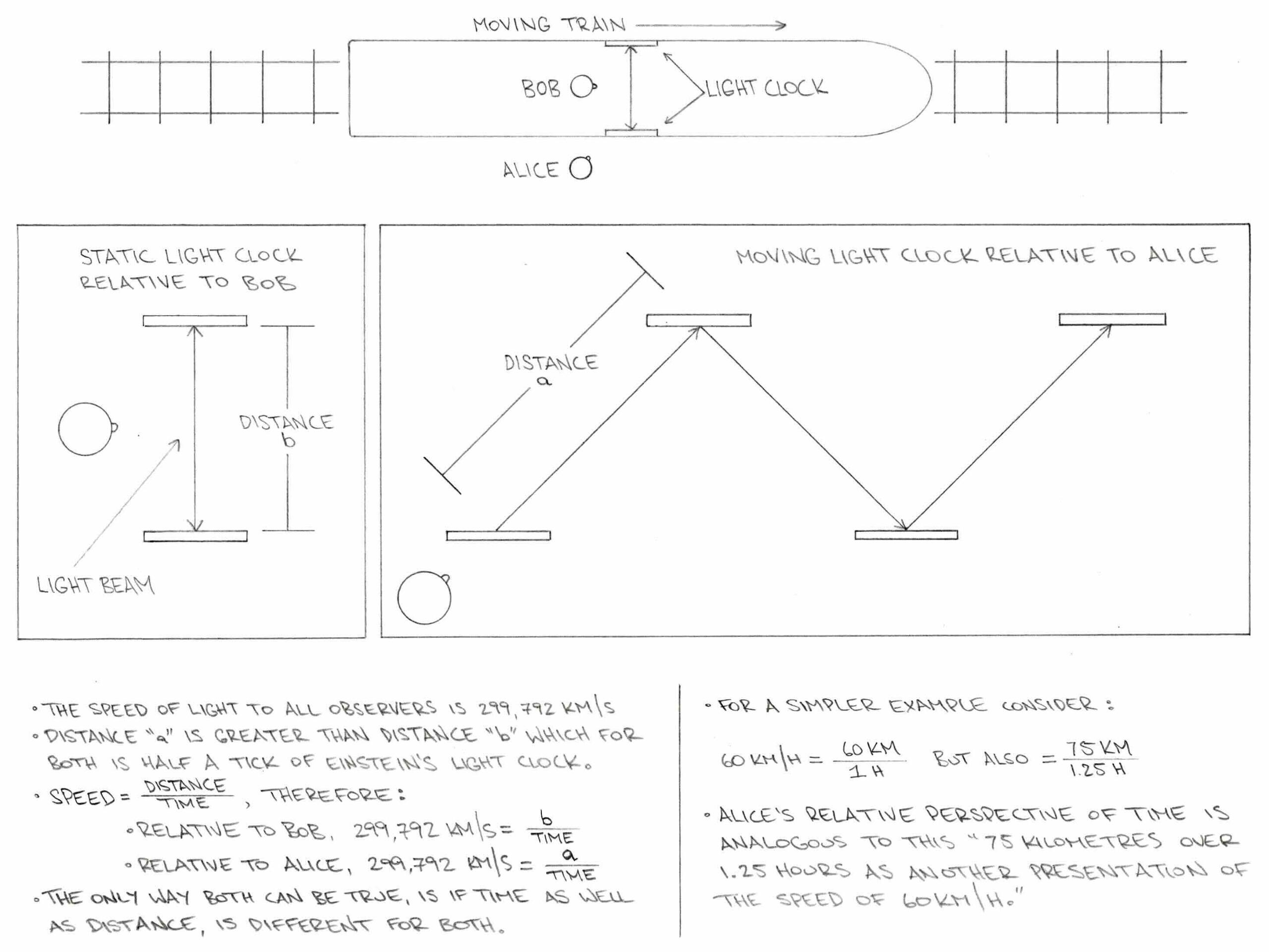
Figure 5.1: Simplified summary of Einstein’s light clock thought experiment.
So that was Einstein’s first crucial thought experiment. For his second we must imagine Alice on the train platform once again, watching as Bob moves past her on a train (which continues without stopping or slowing down at the platform). At the precise moment that Bob passes Alice, two strikes of lightning hit the train tracks at points that are the same distance to both of them. To Alice who is facing the train, they are to her left and right — in front, and behind the train. To Bob who is facing forward in the same direction of the train’s motion they strike in front and behind him. Because light moves at the same speed to all observers Alice will see these two strikes of lightning occurring simultaneously because the two strikes are the same distance to her while she is stationary, but Bob, who is moving towards the strike of lightning in front of him and away from the lightning behind him, will see the lightning in front of the train as occurring just before the lightning behind the train because the light from the lightning in front of him doesn’t have to travel quite as far to reach him. If both Alice and Bob are correct about the timing of the lightning strikes, from their own relative points of view, then once again time, and more specifically events in time, must be relative, not absolute.
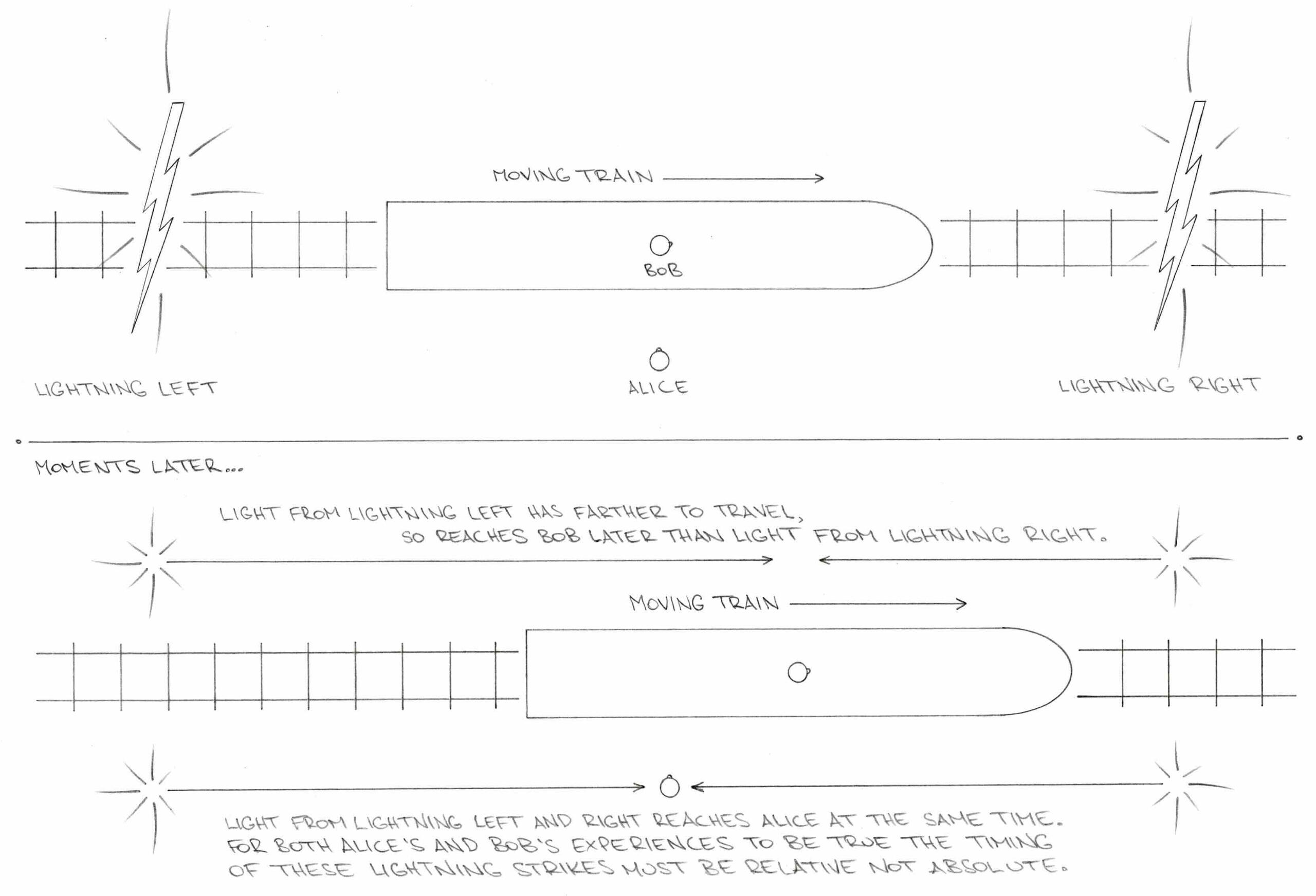
Figure 5.2: Simplified summary of Einstein’s simultaneity thought experiment.
Both of these thought experiments have been experimentally verified and vindicated many times, and the implications that time is relative, and that events can occur at different times relative to the movement of different observers, suggests that events might in some way be pre-existent. But this would suggest that all events that occur in the universe might be in some way predetermined. Einstein would later incorporate his ideas from his 1915 theory of general relativity, which proposed an underlying four-dimensional structure to the entire universe (once again that being: three dimensions of space, and one dimension of time), to envision a "static eternal universe," wherein everything that has happened, and ever will happen, exists in some way simultaneously, as if within a single block of time. Today, and often with a range of variations to account for new theories and findings, this concept is more often referred to as the block universe theory.The reason this highly validated feature of time is considered such a puzzle should be intuitively obvious to all of us. If the universe is predetermined then why do we all feel as though we have agency over our actions? Why do we feel as though we have free will? If we do have free will, how could all events possibly be known already in the block universe of time, or something like it? Considering also that the block universe model would neatly solve our earlier time puzzle, that of no favoured time flow at an elementary level, and the possibility of backward-time-flow-moving particles (or at least the apparent effects of), should we just put our hands up and admit that free will must be an illusion?
It pleases me to share with you that according to this theory at least, if we approach these puzzles with the principle of interaction, we do not have to sign away our free will. I’m perhaps even more pleased that we don’t have to discard relativity either, we simply have to look at it in a new way and with a new model. I must say first though, that this model is only that, a model. It is something that will help to assist in comprehension but should not be mistaken as a fundamental description. Initially, given what I liken this model to, it shouldn’t be too difficult to not take this model too seriously, but as we progress, if your minds are anything like my own there may be a tendency to give greater mental weight to the underling concept and structure of this model. I feel that this would be a mistake. Like Einstein’s fabric of spacetime I expect that if we commit too much of our understanding to this model, either now, or perhaps as it evolves, it may steer us away from more fundamental realisations. I believe what is more important than this model is the principle of interaction, the idea that nothing exists in this universe outside of interaction with something else, but even this too may be a finger pointing towards the moon, which as the maxim goes “if you focus on the finger you will miss all the glory of the moon.”
There are cultural differences in the ways that we think about time as a species, but the prevailing model, or mental approximation of time, in western culture at least, is that of a straight line — a timeline — of unknown or perhaps even infinite length with the present being a moving reference point in the “middle” of this line, the past being anything on one side of that reference point, typically the left side here in the west, and the future being on the other side of that reference point. Einstein’s block universe model is represented in a similar way but as a predetermined three-dimensional block instead of a line. We also have a working concept of time that is inherently circular for the practical reason of tracking the predictable passage of hours and minutes on a clock or watch. This circular tracking of time is shared by sundials too, which is a form that just happens to be one of the simplest ways of tracking the passage of time as a relationship between the rotation of the Earth relative to the Sun.
As I understand it, many of the Nations of the First Peoples to inhabit this country, now known as Australia, have an appreciation of time that is more circular also, or is sometimes even described as a spiral. I believe there’s also an appreciation among many of these Nations that time is not as strictly linear as most of us Westerners believe. Given some of the possible implications of still point theory at large, I would love to have the opportunity to one day share ideas and learn more about all this in direct conversation with some of the Aboriginal and Torres Straight Islander peoples here sometime, but until then let me share my ideas as they stand right now.
For this particular model, still point theory also describes time through use of a circle. For now I would like us to work off the presumption that our universe is a closed system with a definable starting point, or prime interaction, and a definable end point, or final interaction. (Note that I personally believe it may not be as straightforward as this but for our current working purposes it doesn’t much matter.) This allows us to represent the entire time span of our universe as if it were a circle or a disc, and with a single line drawn somewhere from the centre of this disc, taking the shortest path to somewhere on the edge (a radial line) we can mark the beginning of the universe and the end of the universe as starting and terminating on either side of this line. In my own mind I tend to think of the radial line going straight down from the centre, with the start of the universal time span beginning on the right side of this line and the end of the universal time span ending on the left side of this line. This is just how it’s always been in my mind, perhaps to distinguish it from a clock, but these details don’t really matter.
If we were to now imagine another line which starts at this line and then sweeps across the entire circle in a full arc coming to rest at the line again, this is what I like to think of as approximating the apparent movement of the present moment. This line however is really just a reference and not an intrinsic feature, but this will make more sense as we progress. Another, and perhaps slightly more intuitive way to think about this (especially for the music-lovers) is that rather than this line sweeping across the circle in a full arc, the line stays where it is with the disc itself rotating clockwise underneath, much like a vinyl record spinning on a turntable. Because of this, for this model I would like to coin the phrase “universal turning” to suggest a full turn of the time disc, representing the full span of time for our universe from its beginning to end.
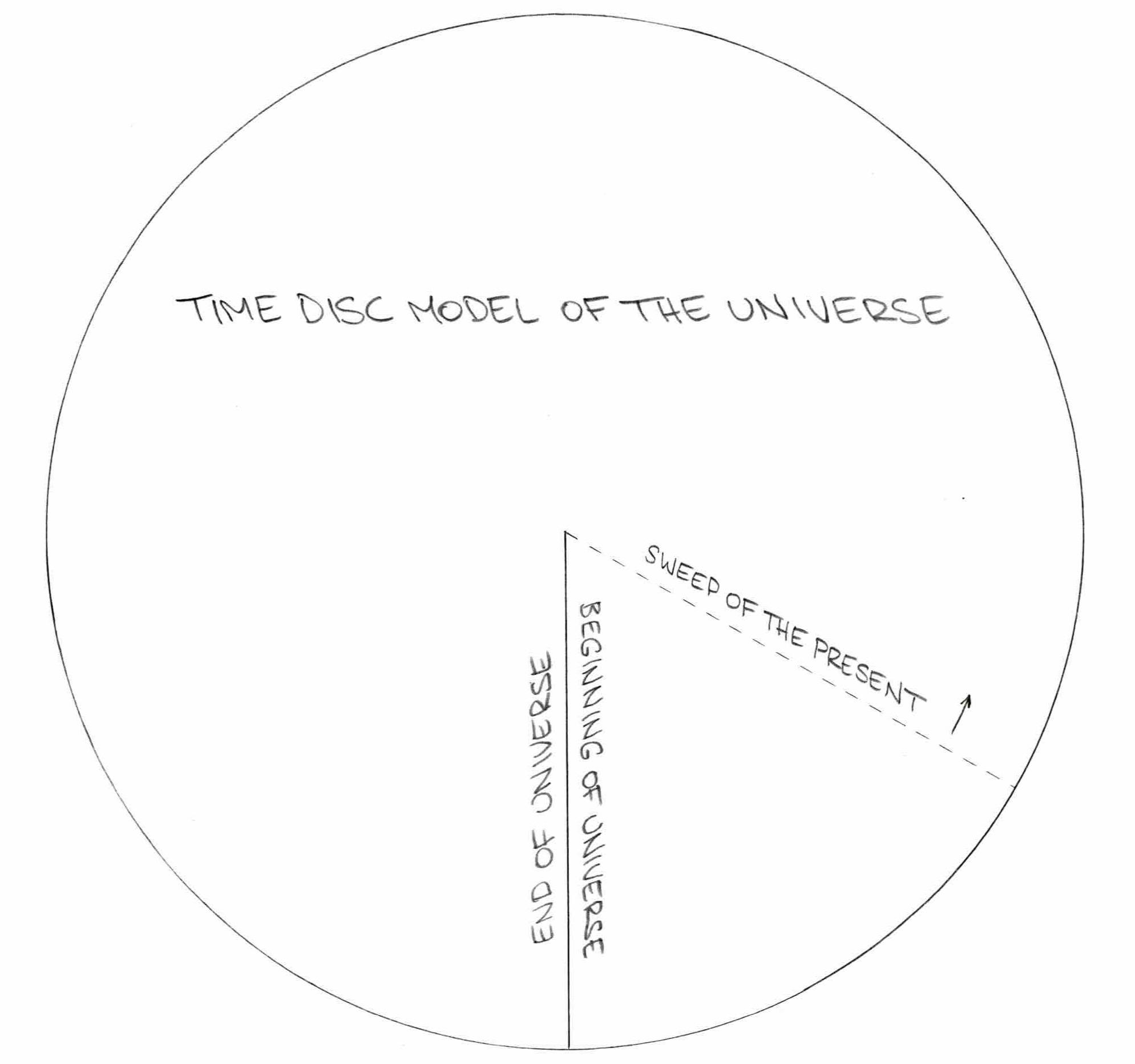
Figure 5.3: Time disc model showing the “universal turning.” One full universal turning is the sweep of this radial line of the present (or the rotation of the disc beneath it) from the beginning of the universe to its end.
So what makes up the vinyl itself then? Given this is a model based on the principle of interaction, the record — the entire space that fills the inside of this time disc — represents all of the interactions that take place in our universe, but rather than specific regions along the radial length of any slice of the present moment representing specific interactions, what this model of time allows us to do is develop a sense of the relativistic relationships of different systems of interactions. To make sense of this though let’s return to Alice and Bob.
In the first of Einstein’s thought experiments, with the time clock on the train, Alice if you’ll remember is stationary at the train platform, while Bob is travelling on his train at an accelerated frame of reference compared to Alice. For ease of comparison from an environmental interaction point of view I would now like us to imagine that Alice is actually in a train identical to Bob’s, but which is stationary in a siding at the train station. I would also like us to imagine that, unfortunately for Alice and Bob, they will now be spending their entire lives in these comparable frames of reference, and if we continue to suspend realism for the time being I would like to make it easier to think of these very Earthly examples of the lifespans of Alice and Bob relative to the lifespan of the universe, by shortening the age of the universe to a mere 1,000 years. Also, lets imagine that Alice and Bob are subject to the extraordinary coincidences of being born at the exact same moment, and both of them having wonderful health for their entire lives, enabling them to live for exactly 100 years, so exactly one-tenth of a universal turning, that is at least, under Earthly particle interaction conditions; which brings us to our next point.
I would also like us to imagine that for this particular relativistic reckoning we are representing frequencies of interactions relevant to humans here on Earth as lying just a short distance away from the edge of our disc. So for Alice, who is in her stationary train in the countryside, let’s also say with the windows of the train open, Alice is surrounded by the kinds of natural interactions at the natural velocities that humans have evolved with, and therefore has her entire 100 year lifespan represented by interactions that exist along a concentric circle on our time disc — similar to a track of music on a vinyl, but just not spiralling inwards — which is just a short way in from the disc’s edge. Specifically her lifespan being one-tenth of the 1,000 years of our grossly shortened universal time span, the interactions that represent her life on this track take up one-tenth of this concentric circle that is just inside of this disc. But what are these interactions that represent her life?
If we imagine that the interactions on this disc are much like the interactions that produce music on a vinyl record, we could think of them as being tiny little bumps and grooves along this track, but unlike a regular record, which has a slowly tightening spiral of a track allowing for a continuous runtime towards the centre, this disc represents systems of interactions that we wish to understand relative to other systems of interactions, so unless we’re looking at a specific system whose interactions could be represented as gradually increasing rates on a gradually tightening track, the tracks on this record tend to be complete circles, concentric circles, individually getting smaller and smaller towards the centre, or larger towards the edge, but not as a continuous spiral like those on a vinyl record. So let’s now imagine that Alice’s life can be represented by a particular song, within a track near the edge of this disc; a song which lasts for one-tenth of a full universal turning.
Because this track represents interactions that are typical of Earth, before and after her song are bumps and grooves of a similar pace and rhythm to those of her song, but which are not her song, are not her life; they are the bumps and grooves describing typical interactions on Earth. To distinguish between the songs that represent the lives of Alice and Bob, and the interactions that are typical of Earth, I would like to simplify this model by making these other kinds of interactions of a consistent type. If we were to play Alice’s track as if it were a song on a vinyl, when we hear these interactions that surround Alice’s song what we hear is birdsong of a pace and rhythm that is similar to Alice’s song, representing standard, human-scale Earthly interactions. And introducing one last feature to this model for now, I would like to suggest that because this time disc provides us with an appreciation of relativistic particle interactions, and in this specific case, particle interactions relative to Alice in her Earth system, I would also like for the rest of our record, for all the regions not represented by travellers moving at different speeds relative to Alice, to be populated by this same birdsong, but with one important caveat: the rate of this birdsong needs to increase on every track closer to the centre from Alice’s track, making it sound faster. Conversely, the rate of this birdsong must decrease on the few tracks available between Alice’s track and the disc’s edge, making the birdsong on these tracks sound slower.
Why this caveat though? Because we’re looking at differing particle interaction rates here, and because a full turn of the disc from start to finish is a full turn of the disc from start to finish no matter which track we are examining, if we want to look at how interaction rates may be represented in time relative to Alice, the baseline of birdsong that represents the environment surrounding Alice must be appropriately “increased” on tracks that still represent a full universal turning but are physically shorter than Alice’s entire track. So on a track that is half the length of Alice’s entire track (from the start of the universe to the end — not the portion of this track that represents Alice’s song), the birdsong would have to sound twice as fast as the birdsong on Alice’s track. Because this birdsong is created by the bumps and grooves in the tracks of the vinyl, these bumps and grooves would basically have to be twice as close to each other as they are in Alice’s track.
So the closer we get to the centre of the disc the faster the birdsong will sound on these shorter tracks. On the final tracks leading up the the centre, these bumps and grooves will be so close together I imagine that individual tonal qualities may no longer be discernible, replaced instead by increasingly subtle but constant tonal variation — to our ears at least.
Another way to think about these typical relative frequencies of interactions as represented by the bumps and grooves of a vinyl record, and a way to more easily represent this pictorially, is by imagining that these bumps and grooves of Alice’s life, and the surrounding birdsong, are the 360 individual degrees that make up the circle of our time disc. In figure 5.4 the 36 degrees that represent Alice’s lifespan of one-tenth of the universal turning, are surrounded on her track by degrees of the same spacing representing Earthly birdsong interactions. When looking at the spacings of this birdsong as we near the centre of the time disc we see that these degrees become more closely spaced, until eventually converging at the centre. This is yet another way to think about it, with my sincere apologies for this thickening lasagne of analogies. I use these analogies with the aim of increasing comprehension and hope that I am not doing the opposite.
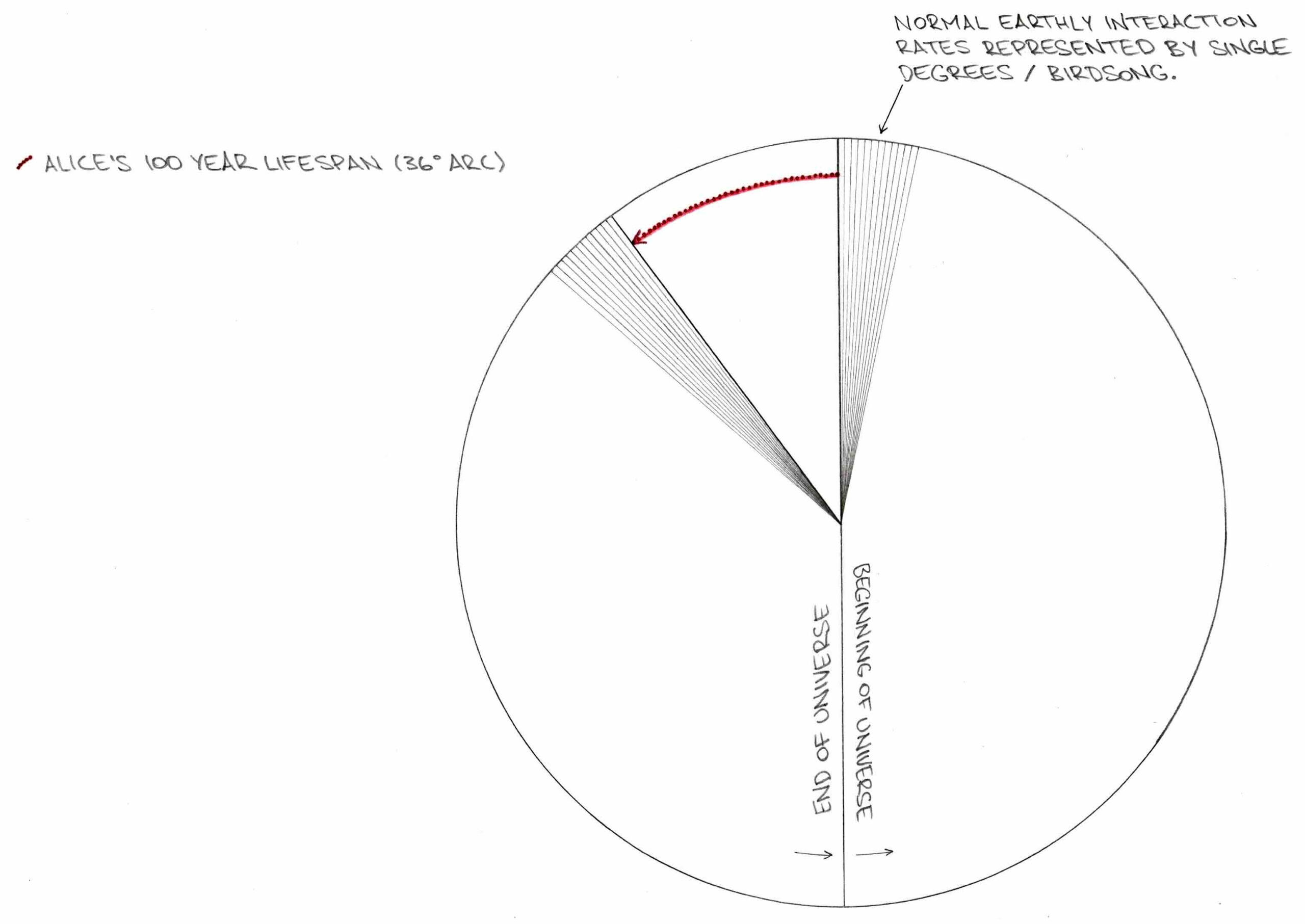
Figure 5.4: Time disc model showing Alice’s track.
But what about Bob? (Ha! Bill Murray gold.) Given all these parameters how do we represent Bob’s life spent in a train carriage moving at a greater velocity relative to Alice? Well firstly, let’s figure out where Bob’s life, lived under greater acceleration, should be situated relative to Alice.
It’s true that Bob’s life on his train means that he is moving at a greater velocity than Alice, but because the train has been built so that its guests can live in comfort and experience none of the inconveniences of living at a greater velocity (aside from the unavoidable effects of acceleration, deceleration, and turning) Bob doesn’t really feel the effects of this travel. What that means from a particle interaction point of view is that the particle interactions that Bob experiences inside his train cabin are of the same rate to him that he would experience if he were on a stationary train. What this means in terms of pressing all of the bumps and grooves in our time disc that represent the interactions defining Alice and Bob’s lives, is that the bumps and grooves of Bob’s song, in his track, would be identical in pace and rhythm to those of Alice’s song. Which also means that his song would run for the exact same amount of time as Alice’s (representing their own experiences of living 100 years) regardless of where it is on the disc. In terms of degrees, this means that Bob’s song, representing his life as a portion of his individual track, is still composed of the same 36 degrees, and with the same spacings, as Alice’s song. But where is Bob’s song on the disc, we’ve still not answered this?
If Bob’s train was also stationary in the countryside, his life would be represented exactly the same as Alice’s. Being born at the exact same time and both living exactly 100 years, they would be precisely superimposed over each other. But as we’ve established Bob’s train is not stationary in the countryside.
Despite Bob himself not experiencing any of the effects of travelling though the countryside at speed, the system of particle interactions that Bob finds himself safely nested within — his train itself — does feel the effects of his increased velocity. Much like the chess piece example from earlier, the particles that make up Bob’s train are experiencing a greater frequency of interaction with the particles in the surrounding environment than they would be if the train were at rest. The wheels are spinning rapidly on their axels, generating a lot of friction and heat energy among the particles making up the train’s own system of locomotion, as well as imparting some of this increased energy onto the particles that make up the rails underneath and the air around these rails. The particles that make up the exterior of the train are undergoing greater interaction with particles in the air around them as the train pushes its way through these air particles at a greater velocity. All of the particles which make up the engine system of the train are also undergoing much more rapid interactions within a common span of time than those in Alice’s stationary train.
Another way that we can think of this greater rate of particle interactions is as more particle interactions within a universal turning. If Bob’s train were to travel at this greater velocity than Alice’s stationary train for the entire time span of the universe, the particles that make up Bob’s train would experience more particle interactions over that whole turning than Alice’s train. So, much like the birdsong, which must be represented with more closely spaced bumps and grooves the closer it is to the centre of the disc, the greater densities of particle interactions of Bob’s train compared to Alice’s would place Bob’s train (with Bob’s song safely nested inside it) a little bit closer to the centre of the disc than Alice’s train/song. Because at this stage we’re just comparing the time dilation effects on our human thought experiment volunteers, that being Bob’s experience relative to Alice and vice versa, we don’t actually need to represent Bob’s train as its own set of bumps and grooves in this vinyl, we simply use the greater densities of it’s particle interactions within a universal turning to establish how much closer to the centre of the disc Bob’s song would be (which greatly simplifies this model for now).
This placement wouldn’t be much closer to the centre however, at the speeds that Bob travels in his train built to human standards. Depending on the size of the disc and other relative interaction rates we are considering, (and in the interests of keeping things visually simple for now, with relative track placement not to scale with what we would actually observe in this situation in reality) we could effectively think of it as the next available track on the record, but the point is, it is closer to the centre, and therefore like Bob in Einstein’s thought experiment, there will be a mathematically measurable difference in his passage of time relative to Alice. One way to know this in our model would be to listen or measure for any differences in the rate of birdsong that exists on Bob’s track on either side of the bumps and grooves that make up his song, and because Bob’s song is on a track that is slightly closer to the centre than Alice’s, the surrounding birdsong would sound faster to him than if he were stationary; in just the same way that Alice would seem to have aged just that little bit faster compared to himself. If we are measuring the degrees that could also represent their songs and their surrounding birdsong, we could measure the slightly closer spacings of these birdsong degrees, relative to the spacing of his own song; and here we must also remember that because Bob is safely nestled within the protective exterior of his train he does not experience any greater particle interaction rates than Alice, so Bob’s song is represented by the same number of degrees (36°), and with the same spacings, as Alice’s song.
Conversely this model also suggests to us that if the particles of Bob’s train were to be interacting with its surroundings less frequently than Alice’s train — not an easy feat but if for instance Bob’s train were in a very slow orbit outside of Earth’s atmosphere (in space) with the train experiencing greatly fewer particle interactions with the vacuum around it, and orbiting at a low enough velocity that it results in fewer particle interactions overall — this would place Bob’s track farther away from the centre and closer to the edge of the disc than Alice’s. Here, the surrounding birdsong would sound slower relative to Alice’s track. This actually gives us some clues to how this model works with general relativity as well, but we will get to that soon enough.
As it is however, in our more Einsteinian example back on the train tracks, Bob’s accelerated frame of reference, his song, which represents the same amount of runtime as Alice’s, but is closer to the centre of the disc than Alice’s, will sweep in a slightly longer arc around the centre of the disc, which is another way of saying it will experience more universal turning. To be clear, his song is not longer at all, it is exactly the same length as Alice’s, but because it is on a track that is closer to the centre of the record than Alice’s, it arcs around the centre just slightly farther than Alice’s, therefore representing a greater degree of universal turning. Despite living the same amount of time as Alice from his own point of view, relative to the overall sweep of elapsed time in the universe, he lives longer. In terms of degrees on the time disc, we could say that despite Bob himself having a life of only 36 degrees in length, that is, 36 markings denoting his life/song just like Alice, if we were to measure the actual degrees that his life/song takes up on his own track on the time disc, we would find it to be greater than 36 degrees. In figure 5.5, which to stress again, is only a conceptual representation and not indicative of the actual relative speeds of Bob’s train travelling through the countryside compared to Alice’s stationary train, Bob’s life/song is a 37 degree arc of his own track, making his life 102.77 years long relative to Alice’s 100, despite being made up by the same 36 markings and spacings as Alice’s life/song.
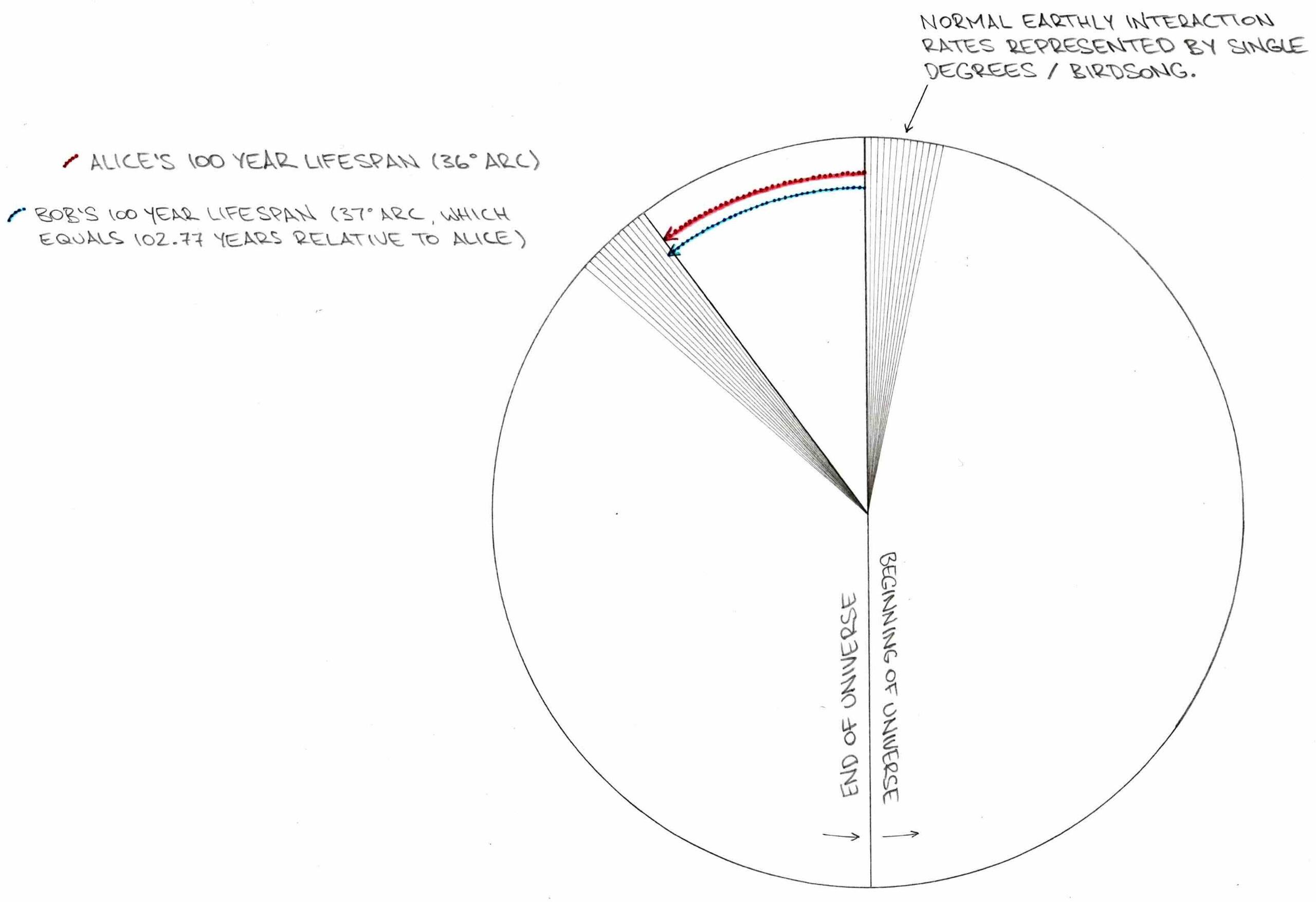
Figure 5.5: Time disc model demonstrating special relativity, showing Bob’s track relative to Alice.
Perhaps for a moment let’s think of a more extreme example, let’s think of Charlie another healthy would-be centenarian born at the same time as Alice and Bob, but rather than sitting in a stationary train on Earth, or a train moving through the countryside, Charlie has some extraterrestrial friends who’ve given her a space-travelling train. With this highly-advanced train tech. Charlie is able to travel a much greater fraction of the speed of light, placing her train halfway between the edge of the disc and its centre, in this present model at least, which is ultimately relative to Alice. Because Charlie is also sitting comfortably in the sealed, Earth-like interior environment of her train, her song is also the same length as Alice and Bob’s, and if it were on the same track as Alice’s it would also take up one-tenth of a universal turning. But Charlie’s train is not on the same track as Alice’s, it’s on a track halfway along the radius of the disc, so Charlie’s song takes up roughly one-fifth of this particular track of universal turning, meaning she will live for one fifth the age of the whole 1000 year-old universe. In terms of degrees, despite Charlie’s life/song still being made up of the same 36 markings at the same spacings as Alice and Bob’s songs, Charlie’s song takes up 65 degrees of her own track, making her life 180.55 years long relative to Alice’s 100. The birdsong on Charlie’s track surrounding her song would be of a noticeably greater rate than that of Alice and Bob’s tracks also.
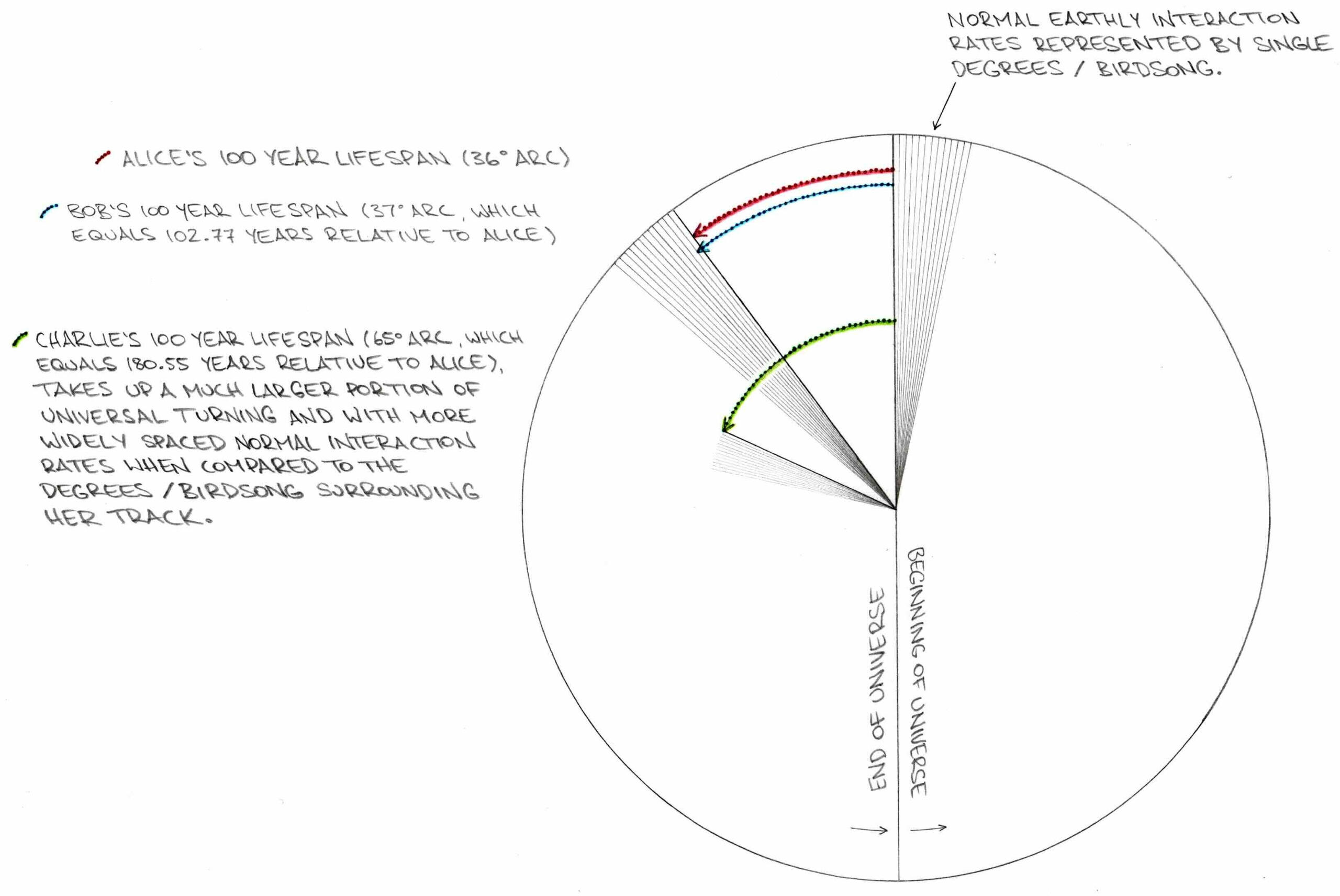
Figure 5.6: Time disc model demonstrating special relativity, showing Charlie’s track relative to Alice, and Bob.
In reality, on a train travelling through the countryside Bob’s situation is similar, although far less pronounced. With the purely illustrative representation of figures 5.4 - 5.6 aside, which would give Bob roughly 103 years relative to Alice’s 100, in reality even living on the fastest train on Earth, which still travels at such a small fraction of the very significant speed of light, Bob really only gains the merest fractions of a second over the course of his entire 100 years relative to Alice, but it would still be true to say that his song does experience slightly more universal turning relative to Alice’s, and with precise enough measuring equipment his life would be measurably longer as a result of his travelling safely within a system that interacts with its environment with greater frequency. This in itself is another way of saying that despite experiencing for himself the exact same number of years of life as Alice experiences for herself, Bob’s song will take up more of his own track, more of his own concentric circle than Alice’s song does. Bob will outlive Alice, despite having lived the exact same amount of time from his own point of view, as Alice did from her own point of view. This is the same result as that was achieved by Einstein with special relativity, and there are some neat advantages to thinking of it in this new way.
For starters, it gives us a fairly straightforward way of thinking about non-favoured frames for relative motion. What I mean by this is the idea that there can be no favoured frame of reference for motion in the universe, a direct finding of relativity, which can seem to create paradoxes when we’re dealing with the very obvious effects of certain, very clearly favoured frames of motion, that for example, produce time dilation. One example of this is the twins paradox, which although not being a paradox at all, is often described that way because its solution isn’t intuitively apparent, and involves a more advanced understanding of Einstein’s relativity theories.
If we make Alice and Bob our twins, the paradox goes something like this:
Because there can be no favoured frame of reference for motion in the universe (as special relativity made clear — just think of Einstein’s light clock and simultaneity thought experiments), Bob traveling away from Alice at high velocity on his train could (seemingly) equally be Alice travelling at a high velocity away from and relative to Bob. I mentioned an intuitive appraisal of this in the first chapter: the odd feeling of sitting on a moving train but not feeling like we are moving. Despite the landscape moving past our windows at high speed, because we don’t necessarily feel like we are moving, one could wonder if it is in fact the landscape moving past us at high speeds, and not what makes more intuitive sense. Despite it being infinitely more logical for us on the train to be moving through the landscape, both are in fact mathematically equivalent. If it somehow were true that the landscape and the Earth and rails beneath the train were moving past the train in ways that simulate travelling at speed, and even speeding up, slowing down, and turning, we on the train would feel the exact same sensations. If this were the case, and if there truly can be no favoured motion in the universe, then how can we decide which of our twins ultimately experiences time dilation, because in reality only one of them can actually live longer than the other as a result of high velocity travel.
To make clear in another way, in the classic twins paradox Bob would not be travelling on a train, he would be travelling in a spaceship to, let’s say our nearest star outside this solar system, at some notable fraction of the speed of light, and would then return to find Alice has aged relative to himself as a result of special relativity. The so-called paradox is that if there is truly no favoured frame of motion, then could we not see this situation as instead being Alice, on Earth, and in a surrounding moveable universe that includes our nearest star, moving relative to Bob, who is actually stationary? In this situation it would be Bob who ages relative to Alice, but only one of these can be true. The latter description of this scenario makes no sense intuitively but seems at least mathematically plausible if there can be no favoured motion in the universe, as suggested by Einstein.
As mentioned, there is a solution to this in a more nuanced understanding of relativity, but I would like to offer a new way of thinking about this based on particle interactions also. Instead of conceptualising what is effectively the geometry of light bouncing away from one observer relative to another, providing us with a mathematical proof, with our time disc we can instead more intuitively appraise the relative rates of particle interactions represented by the various systems we are observing as a whole (and of which I’m sure a mathematical formulation could be made, but certainly requiring a more able mind than mine). In this case, despite moving away from Bob at the same velocity that Bob is moving away from Alice, Alice is the one who ages faster relative to Bob because she is still interacting with her environment at a reduced rate compared to Bob’s train. Alice is not moving relative to the broader system of Earth (and its nominal particle interactions), within which both she and Bob (Bob, in the Earth-like interior of his train at least) exist within. Whereas Bob’s train is moving relative to this larger system. It is this greater rate of interaction of Bob’s train with this larger system which distinguishes Bob from Alice, eliminating potential paradoxes. There are two very distinct particle interaction profiles describing their two situations, which I expect with some new mathematical formulation would provide the same proof as special relativity, but hopefully without the crutch of geometry and it’s tacit implication of a fundamental spacetime. Absent this potential mathematical formulation, within my more modest and certainly imperfect time disc model, the greater particle interaction profile of Bob’s train relative to Alice’s, places Bob’s song on a track of universal turning that is closer to the centre of the time disc, and therefore experiences more universal turning than Alice.
Just to be clear, and to tease out some more advantages of thinking of relativity in this new way, according to this theory Bob experiences time dilation because his direct interactions with his environment are as they would be if his train were stationary, because the system of the interior of his train is effectively sealed off from the much higher rates of particle interactions taking place outside the train around him, due to his train’s higher velocity through the landscape. If Bob were sitting on the roof of the train and subjected to these much greater rates of interactions, the particles that make up the outer layers of his body would be exposed to these much greater rates of interactions, which if we remember from our chess piece example from the previous chapter, equates to greater energy transfer over a common span of time — over the course of his life — relative to Alice whose body is not exposed to these greater interactions. I would argue that this exposure to greater interactions as a result of spending his life on the roof of the train, purely at the level of the greater rates of particle interactions taking place in the outer layers of his body, would likely negate and even reverse the small potential time dilation effects achieved by Bob travelling at speed. Now, he would not live longer relative to Alice. I actually expect he would live a noticeably shorter life instead. Something we can again consider with regard to all of the new technologies that impose new interaction pressures on our bodies and systems of consciousness.
This is an important distinction to make because it is the heart of this new way of understanding time, and time dilation. The particles that make up our bodies only know what time is, based on the kinds of interactions that we have evolved with. If we can maintain these kinds of interactions, while travelling at high speed, then we will experience time dilation relative to someone living in that environment we have evolved in, because we are effectively protecting the particle system that makes up our bodies from the much more energetic particle systems that are interacting with the exterior of the system that is protecting us. As a result of this protection while travelling at high speeds, our particle systems age less compared to someone who has remained in the system where our particle systems have evolved, because these Earth-dwelling particle systems are still interacting with Earth’s environment at their normal rates, whereas our particle systems, relative to those on Earth, due to their increased velocity, are now interacting with their environment at the slightly slower rates that Einstein’s special relativity has made clear to us.
We can see this again in figure 5.6, by looking at the spacings of the degrees that make up Bob’s and Charlie’s songs, relative to the degrees that make up the birdsong surrounding them on their tracks. The bumps and grooves, the degrees, of their own songs are more widely spaced, and therefore “slower” compared to this birdsong. If we, on our fast-moving train, were suddenly exposed to these much higher (much more “energetic”) particle interactions, then I would argue that the longer-living effects of time dilation would be nullified. Obviously the degree to which they would be nullified would depend on the combination of various factors such as the speed of the train, and the degree to which we are exposed to the fast moving environment we are now moving through. Sitting on top of the train would be worse than simply sitting next to an open window on the train for example, but both would play their part.
Even for Charlie, who is travelling at much higher speeds in her space-train, and if perfectly protected from the space environments speeding past her beyond its hull, and who would live much longer than both Alice and Bob (despite living only 100 years from her own point of view), if she were instead exposed to intermittent bouts of space radiation that were able to pass through the hull, whilst potentially still living much longer than Alice and Bob due to the effects of time dilation, her body might have to draw upon healing resources that Alice and Bob’s bodies do not, and so Charlie might therefore not live her full 100 years. Again this would somewhat negate the effect of time dilation; and this, purely as a result of thinking of relative rates of particle interactions.
I expect many of these suggestions may offer testable hypotheses to the experimentalists out there too.
And as a more humorous, but in my family a deeply serious aside, it also makes me wonder if the Millennium Falcon from Star Wars looks so beat-up, simply because it’s the fastest Corellian freighter in the Galaxy, and therefore subject to the most intense rates of particle interactions, making it age more quickly than other Star Wars space vessels. Of course the fact that Han and Chewy are so busy running from gangsters and soured deals that they have so little time to counter these higher-particle-interaction rates with the appropriate external space-particle sealers and the like, is probably also a contributing factor…
But the crux of all of this is, that this model, by effectively plotting experiences relative to particle interactions over time, rather than distances over time, allows us to understand special relativity in a very different way from its geometrical underpinnings. Hopefully this will allow for a new mathematical understanding of special relativity in time (pardon the pun), and in my opinion once you get the hang of this new particle interaction way of thinking, we are led to an understanding that is far more intuitive, and as we delve more deeply, far more revealing also.
~
Last Track | Track List | Next Track
— Track 6 —
Gravity and Its Axes
(Positional axes, not slasher films' or guitar gods')
“In a consistent theory of relativity there can be no inertia relatively to ‘space,’ but only an inertia of masses relatively to each other.”
~ Albert Einstein, 1917
I appreciate that by this stage (if not much sooner), the more learned readers among you may be objecting to all that I have been leaving out. I appreciate that there is much more detail to all of this that I have not been covering. The wave function of quantum mechanics for example, or what might seem like a somewhat reductive approach to defining consciousness, or perhaps the very elegant underscoring of mathematical principles adapted from classical physics and modified to wonderful effect in special and general relativity. The fact that most of these ideas and theories are principally explained through the language of mathematics, and through precise and very detailed mathematical frameworks that have been established through centuries of rigorous debate and experimentation, is not something that I mean to belittle in any way. I do appreciate that I have been bypassing much, and certainly, due to my lack of formal study in these areas, I am probably also missing much too. We are, after all, dealing with theories that have taken hundreds, if not thousands of years to evolve to where they are today. Without formal study there is much I will be unaware of. But it does seem to me that all of these theories, and their mathematical frameworks, seem to require an understanding of space and time that is fundamental. Questioning this requirement is central to my challenge, and the reason my line of enquiry may seem to bypass much — and certainly much of proven value to modern science.
I guess I should state at this point (perhaps a little late) that it’s not my intention to prove this theory formally, or disprove any others; I am simply not qualified to do this in any meaningful way. Instead, perhaps a bit more like an artist I suppose, I would like to lay bare an alternative way of looking at the world in the hopes that this new depiction might still offer some nuggets of insight, new avenues of enquiry, or perhaps just a new way of looking at familiar landscapes. And like a painting, if this landscape is not deemed to be of value in a more traditional sense, perhaps as an abstract it may be seen to have some beauty nonetheless? Art for arts sake perhaps; or maybe even this praise is too high? We shall see…
I say all this as precursor to the following, as much as for ground already covered, as I am about to offer what I believe are much more serious insights regarding Einstein’s second ground-breaking theory, that of general relativity, and underneath this remarkable intellectual tower I feel especially small and unqualified. But again, with the principle of interaction in mind, I feel there are a few interesting ideas worth considering at least.
Einstein’s theory of general relativity, otherwise known as his theory of gravity, was inspired by an idea that he later described as being “the happiest thought of his life.” It was the thought that a person in free fall from the roof of their house could be as equally described as being in a state of zero gravity, as an astronaut in deep space undergoing no acceleration. That this would be the happiest thought of his life marks his devotion to theoretical exploration. Either that or it marks his well-known affinity for irreverence and humour. Either way it’s telling, in the best of ways.
Now, the gist of this thought experiment is that if this person in free fall, or in deep space, were to be enclosed by a windowless box, they would have no frame of reference to help them distinguish which of these two states they were in. In both this box in free fall, as well as in deep space, they would appear to be floating freely, and if they were to let go of an apple in their hand it would appear to remain floating there with them. Einstein called this his equivalence principle and it was included in his paper outlining general relativity in 1915. It was a principle that basically stated the equivalence of inertial mass and gravitational mass, and much like the many experiments over the last century that have been unable to disprove special relativity, his equivalence principle, and general relativity, have also withstood all scientific scrutiny to date.
But what does this mean, that inertial mass and gravitational mass are equivalent? It basically means that the effects of gravity, like the passage of time in special relativity, are relative to one’s frame of reference.
We can see this in the example of the person falling from the roof of their house, as by being in a state that’s indistinguishable from floating in deep space. Or conversely we could see this in another common example, that of a person standing in another windowless box, like a small windowless room within Earth’s gravity. When someone in this room drops an apple it falls at the rate of all objects in Earth’s gravity near ground level, of 9.8 metres per second squared; or put another way it’s velocity increases by 9.8 metres per second with each passing second (until reaching what’s called terminal velocity and can fall no faster due to air resistance, but that will not happen in this scenario). But what if this person failed to realise that this room was actually inside of a rocket? If this person fell into a deep sleep (a very deep sleep!) prior to this room being loaded onto a rocket and launched into space, and if this rocket then travelled with an acceleration of exactly 9.8 metres per second squared, when this person awoke they would not be able to tell if they were still in this room within Earth’s gravity, or if this room was actually inside a rocket accelerating through space. Their mass would feel the same effect against the floor of their room whether it was being “pulled” down by Earth’s gravity or “pushed” down by the acceleration of the rocket. If they dropped the apple here, again it would behave the same in both scenarios.
Einstein then used these thought experiments to create a very precise theoretical and mathematical framework to re-evaluate gravity as no longer a force, as envisioned by Sir Isaac Newton, but rather as simply the way that objects move within the curvatures of the combined four-dimensional structure of space and time — aka spacetime. What Einstein’s equations suggested was that rather than the apple falling due to the gravitational force of the Earth, or the force of the rocket’s acceleration, it instead occupied an inertial frame that would have it naturally move along its shortest straight-line path no matter where it was in the universe, or what conditions it was subjected to; a straight-line path not through space alone, as how we traditionally think of travel along straight lines, but instead along the strangely curved geometries of four-dimensional spacetime. In short these highly successful and telling equations are based on geometries that assume the fundamental reality of both space (providing co-ordinates for objects to move among), and time (providing a way to measure relative speeds and temporal associations of objects amongst themselves). Could there be any other way of understanding what Einstein’s equations are telling us though?
Despite providing such clear, precise, and arguably unparalleled universal application to macroscopic phenomena, it was the suggestion at the heart of his equations here, that there might be this continuous structure of spacetime underlying all reality, a “spacetime continuum” as Einstein commonly called it, that would eventually fill him with so much doubt.
If we consider this doubt about the way that objects move within spacetime, in light of the suggestion that perhaps nothing fundamentally moves through the universe at all, then where might this take us instead?
Let’s consider our apple, either falling in Earth’s gravity, or floating in deep space. From the point of view of motion within the four-dimensional curvatures of spacetime we can appraise these two systems as being equivalent. However, when we consider these systems with regards to their inherent particle interactions, much like being able to solve the twins paradox due to clearly different cases of particle interactions for our twins, we can do the same with these two apple systems.
Whilst an apple falling in Earth’s gravity might, to someone falling beside it, appear to be floating the same way that it would in deep space, we can even intuitively discern that the apple falling in Earth’s gravity will be subject to entirely different particle interactions in the air around it (or the system around it) than the apple in deep space. Like our earlier chess piece example, this falling apple will be exposed to a greater number of interactions on its leading edge as it collides with air particles that are not also falling, or not falling/moving in the same direction at quite the same rate. While this being the most intuitive kind of particle interaction that we can think of in this scenario, these kinds of interactions actually counter the effects of the gravitational pull of the Earth. These interactions will actually slow the fall of the apple ever so slightly, eventually causing it to no longer accelerate beyond it’s terminal velocity, and if we were to give the apple a parachute we could further utilise the resistance that these particle interactions provide to allow our apple to reach the ground without so severely compromising the apple’s intricate systems of consciousness (i.e. being smashed to a pulp upon landing). With our intuitive understanding of parachutes and of air resistance it’s easy to understand how particle interactions within a field of gravitational influence would actually slow the apple down rather than increase its likelihood of falling to the Earth, but there is a subtler way of thinking about both the apple, and all of the other particle interactions taking place in the system around the apple, that I think does illustrate how from a particle interaction point of view our two scenarios are not equivalent.
The apple, and its human observer, are not the only objects falling in this scenario. Although we can’t see them, almost all of the particles in the air around the apple are falling too. Now, many of these particles are ultimately constituents of air molecules, which are very light, and due to atmospheric effects may not actually be falling in every given moment, but they are nonetheless being increasingly pulled down to the surface of Earth the closer they get to the Earth’s central mass. Even particles that make up atoms that are lighter than most other air molecules, like hydrogen and helium, appear to defy Earth’s gravity by floating upwards, but this is only until they reach a much higher layer in Earth’s atmosphere. If they were to enter into Earth’s gravitational field above this point they would still fall towards the Earth, they would simply stop at this higher atmospheric layer, or alternatively, electrostatically bond with other atoms and then continue their decent as a new particle composite. So despite all of these airborne particles often remaining in the atmosphere for long periods of time, every interaction they encounter will still include information about the general pull, the general trend in movement, that all objects experience within Earth’s gravitational field. But what is this information exactly? This question for me is really: “What is a gravitational field from a particle interaction point of view?”
If you think of a particle moving through some undefined region, I imagine you are automatically thinking about things like the direction and speed at which that particle is moving relative to some useful point of reference. If we think of two particles as if they are tennis balls on a collision course, most of us are aware, if even only intuitively, that the physics of their collision, of their interaction, can be roughly described as the transfer of momentum from their two directions of travel, into two new directions of travel. In basic terms there is a sharing of information about their momentum — their mass, speed, and direction of travel — which they carry with them as new information in their new direction of travel, to their next interaction with another object.
Let’s think about tennis balls out in deep space now, where there are no additional influences on their momentum and direction of travel, but instead of two tennis balls, let’s think about twenty. If twenty tennis balls are on a collision course with each other in deep space the resulting description of all of these interactions would look rather chaotic, with many subsequent collisions occurring for a period of time after the initial collision, and balls travelling back outward again in all directions. Some of these balls by chance may be travelling outward again more or less together too, for a little while at least. Now let’s think about what two million tennis balls colliding in deep space might look like. After the initial highly dense collision, there would be a long period of many subsequent collisions resulting in many balls bouncing back out alone into deep space, many balls bouncing back out more or less together into deep space, and many balls remaining in the same region of space, still bouncing off and interacting with each other for a much more significant period of time.
If we were to now replace these tennis balls with cricket balls, balls of roughly the same size but with a much greater mass, and therefore effectively slowing each other down much more with each collision, we would witness fewer balls bouncing off into space so quickly and more balls congregating in the same region of space for a longer period of time. Despite these being very loosely defined examples, I think we would be starting to see something that looks a lot more like the gravity we intuitively understand, and I suggest it can be described through interaction and information exchange alone, with no need of an elementary force of gravity, fields, or a fabric of spacetime. But we certainly have a bit more to cover here first.
So in order to translate the picture we’ve just created, of balls colliding with each other in spacetime, into this new theory in which I suggest that nothing inherently moves anywhere, we have to imagine the factors contributing to an object’s movement purely (or at least fundamentally) as information. In much the same way that the nature of a photon’s previous interaction in determining its frequency need not, I believe, be related to actual waves or particle travel through spacetime, these factors of momentum and direction of travel might also be simply part of the information that describes the interaction that one particle has with another. Again, without particles actually travelling through spacetime independently, we achieve consistency of action among all particles by way of consonance of information among all particles within whatever system we are looking at, whether it be a small experimental chamber, or the entire universe, and this consonance becomes much easier if our notion of time, at elementary scales, does not favour one particular time-flow direction or another — which I promise, a full explanation of, is coming.
So if we can imagine all of these deep space cricket balls as particles of a more fundamental nature, and the surrounding space containing nothing that these cricket ball particles can interact with, we wouldn’t see them travelling to the point of collision at all. We would see them at their points of interaction with each other, and then at their next points of interaction, but because of the consonance of information of all of their trajectories relative to each other, if we wanted to create a visual representation of their interactions with each other by drawing lines between one interaction with the next, on and on, we would create a picture of trajectories that could be, given comparable relative factors, exactly the same as the trajectories of our actual cricket balls in deep space. I would suggest that spacetime need not exist for it to appear as though it does, as far as this information of momentum and direction of travel is concerned.
So with all of these particles interacting with each other in ways that are consistent with an underlying fabric of spacetime, as well as fundamental parameters determined by something like our standard model, when one particle interacts with another, the information that describes how this interaction is consistent with all other interactions, and consonant with the larger system of interactions — the information that describes these sets of interactions as their “movement through spacetime” — is altered, which then alters the information that describes the interaction of those particles relative to the next particles they interact with. These slight alterations continue through to each new interaction. If these particles are interacting with high frequency, then based on other informational features of the system, we could surmise that these particles are interacting in a more tightly contained system, or perhaps they’re moving more rapidly — which we’ve already covered could simply be another way of saying they’re interacting more energetically — or alternatively, we could make the opposite inference for less frequently interacting particles.
What I would like to suggest is that when you have a region of particles of sufficient type and sufficient density, a little like our collection of two million cricket balls, as part of our analysis of their interactions as being generally contained within a certain observable region for a certain span of time, and interacting with a certain frequency, and thus a certain amount of relative energy, we would also see movements that are becoming collectively more aligned — so with adjustments that are becoming more similar across the cluster. What might start off by chance with a certain number of particles all demonstrating the same or similar “movement” information, could, over time, sufficiently alter the information describing the apparent movement of enough of those particles within that cluster that they all begin to trend in the same direction or around a common centre, or perhaps just correct each other in a generally unifying way. When a tipping point is reached where the rate of particles entering that cluster from elsewhere and then becoming similarly aligned in movement (that is, aligned in the information that discloses their momentum in a particular direction relative to other particles), where that rate is greater than the number of particles that these new particles displace from the cluster as they enter it, then at that point I would say this cluster of particles has established its own gravitational influence on the surrounding system of particles. This is an effect that I suggest could be produced through particle interactions alone, likely a much more nuanced and complete understanding of particle interactions than I am able to provide here, but importantly, without the need of invoking four-dimensional spacetime curvature, which surprisingly so ired Einstein.
It also helps that at the most fundamental levels of particle interactions there are additional forces that are encouraging these particles to come together in interaction: the electromagnetic force; and the strong and weak nuclear forces. In fact at these elementary scales of interaction any effect of gravity, or perhaps of trending movement information that I’m describing, is insignificant when compared to the strength of these other forces. Perhaps this is the reason why in fact, because gravity rather than being a force, or the way that motion of objects can be described in four-dimensional spacetime, it might instead have some other elusive “atomistic” cause, as Einstein himself pondered. If gravity is less a force as described by movement through four-dimensional spacetime, and more simply the result of the trending information that denotes this movement, then perhaps the key determining factor for considering the relative strength of one system of gravitational influence compared to another, would be the frequency of interactions of particles in that system? This sounds a bit like our description of energy now doesn’t it? Could this be alluding to an underlying connection between energy and gravity, without specifically requiring the concept of mass?
The particles I have been talking about here in relation to this new interaction-based concept of gravitational influence, whilst not excluding elementary particles, certainly has less effect on these particles compared to the electromagnetic, and the strong and weak nuclear forces. These interaction forces are simply many orders of magnitude stronger than any effects of gravity (or alternatively here, of trending movement). Once we move up through the scales of elementary particles of quarks, electrons, and neutrinos, and through their composite structures that form both the nuclei of atoms, as well as the broader atomic structure itself, all of which are governed by the strong and weak nuclear forces, as well as the electromagnetic force, and then as atoms couple and combine in various ways to form molecules, through the electromagnetic force again, it is now at this scale of molecular structures that the trending motion of gravitational influence starts to really come into play. At these molecular scales, at this level of “particles,” the interactions that are taking place are still at a considerably higher rate compared to our human cardinal consciousness level of interactions, which is why I believe that there is a cumulative effect of particles, or more specifically atoms and molecules, that enables this trending of motion that we call gravity to exist at all, but compared to the smaller subatomic scales of particle interactions, like those governed by the electromagnetic force and the strong and weak nuclear forces, these effects of gravity are still tiny.
To give you a better sense of this, the interaction rates of quarks and gluons within nucleons — the composite particles that make up both protons and neutrons in the nucleus of every single atom — are truly unfathomable by human intellect, at least in an intuitive and non-mathematical way. The rate of interactions that are taking place in the centres of every single atom in existence are of such a phenomenally high rate that they completely defy our comprehension. Is it a coincidence then that these phenomenally high interaction rates are also responsible for the strongest fundamental force that we know of in our universe, especially when we consider that as with our chess piece example, energy, at least in one sense, could be associated with this high interaction rate? This strong force, which is determined by the relativistic energy of quarks and gluons interacting inside nucleons, is even greater than the strong nuclear force, which is the scale of interaction that is exploited in the catastrophic release of energy in an atomic bomb. This slightly less strong, strong nuclear force keeps nucleons bound to each other (i.e. keeping protons and neutrons bound together); the strong force itself though, is able to keep the smaller particles known as quarks, bound together inside these nucleons. So despite being an alternative expression of the same force, the strong nuclear force does not see interactions occurring at the same rate as the strong force, and I would perhaps over-simplistically suggest this is the very reason that the strong nuclear force is not as strong as the strong force.
I would also like to suggest that this is the reason the electromagnetic force is not as strong as the strong force. While the interactions of electrons surrounding the nuclei of atoms are also of a phenomenally high rate with other particles, and therefore similarly describe significant expressions of energy relative to much more slowly interacting systems, these electromagnetic interactions are still not of the same extraordinarily high rates as the strong force. The weak force is an interesting case for consideration also, and I will touch on it more later, but for initial comparison it’s interesting to note here that while the weak interaction still operates at the scale of nucleons of atoms, and not in the orbits of, or between atoms (as is the case with electromagnetism), the weak force’s relative strength is actually lesser than that of electromagnetism. I believe perhaps the reason why it’s not as strong, and certainly not as strong as the strong force, is because its interactions are known to be more random and sporadic than these other, more regular interactions, perhaps therefore making them of a generally lower frequency, and therefore also of a lower relative strength?
And perhaps again this is the reason why gravitational influence is seen to be not as strong as all of these other forces, and could in fact be regarded as a relative pipsqueak, because the rates of interactions that describe this influence is at the level of atoms and molecules, and might simply be the result of trending movement within systems containing lots of atoms and molecules, as opposed to being a “fundamental force” between and within the constituent particles of atoms themselves? Relative to the rate of interaction of these subatomic fundamental forces, gravitational interactions are of significantly lower frequency within any common span of time. Could interaction rate then be seen as the bedrock of all of these forces, where gravity is not a force in and of itself because it is really just an expression of the way that these other forces help atoms and molecules trend together in the greater-scale emergent conditions of space and time?
Is it possible in fact, that this idea of interaction rate/frequency itself, is the only truly fundamental force at play here at all? Big question.
In addition, if we consider Einstein’s equation E = mc², we will remember that there is a direct correlation between ideas of what energy describes, and what mass describes. When we consider that these extraordinary rates of interactions taking place between quarks inside the nuclear particles of atoms are not only a description of the energy inherent in these particles, but also the mass of these particles (indeed it’s well established that most of the mass in the universe can be attributed to the interactions, and the “binding force” between quarks and gluons), and when we consider that there might be a correlation between the rate of interactions of particles/atoms/molecules/macroscopic objects and their resulting gravitational influence, does it not seem suggestive to anyone else that this correlation might exist due to rates of interactions actually providing direct descriptions of the energy, and therefore the mass also, of these either quantum or macroscopic objects? In other words is it not suggestive to anyone else that mass and gravity might be correlated because mass/energy and interaction rates are correlated?
If relative interaction rates are indeed the underlying cause of gravitational influence, then rather than needing a much sought-after theory of quantum gravity in order to unify relativity with quantum mechanics, perhaps what we’ve actually needed is a theory of quantum relativity, focusing on a deeper understanding of energy/mass, rather than apparent movement through spacetime?
I appreciate that this may all sound ridiculously over-simplistic, but remember all we have done here is ask whether it’s appropriate to assume that something can exist when it’s not in interaction with something else. No one has ever observed or measured anything not in interaction. In a way this is the very definition of “observation” or “measurement” — we must interact with these things in order to do so. But if instead we question this assumption, and all the laws of motion that have stemmed from this assumption, we get a solution like the one I am presenting here, where perhaps nothing exists when it’s not in interaction with something else, and in the absence of notions of fundamental motion, or four-dimensional spacetime, we are left trying to understand universal phenomena purely, or at least initially, from the point of view of particle interactions, of information exchange, and of relative rates of interactions instead.
But let’s bring this all back to our falling apple scenario.
What I would now like to suggest from a particle interaction point of view is that the system of the falling apple is not equivalent to the system of the apple floating in deep space, because there are two totally different interaction profiles acting upon the apple in these two systems. Because the apple is floating in deep space, which is a vacuum and therefore largely devoid of particles, this apple will have an almost non-existent rate of interaction with particles in its surrounding system, and any interaction it does have will be with particles that contain movement information from their last interaction that is largely random relative to our apple. At the scale of particles we could see this as all of the particle interactions that make up the apple interacting with very few particles in the system surrounding the apple, and of these few interactions there would be no consistent trend in movement information exchanged, and therefore no significant gravitational influence.
The falling apple on the other hand is not only surrounded by particles, but also particles that are more likely to be carrying information from their previous interaction that will be suggestive of the generally downward trend of all particles in Earth’s field of gravitational influence. It’s at this point that I simply don’t know how much of an influence all of this trending momentum information at the scale of particle and atomic interactions, and at the rates that are applicable to these scales, could cumulatively affect a macroscopic object like an apple falling through the air. The suggestion of this theory is that it should be enough to accomodate for the gravitational influence that we very precisely observe here on Earth, but perhaps this view of generally trending cricket balls in deep space alone is not enough to accomodate for this? Perhaps there is something else at play here though that can help us out?
It occurred to me while thinking about our parachuting apple and the resistance to falling due to particle interactions that all objects in a field of gravitational influence must experience to some degree, how the interactions that define this resistance to falling would be a greater number of interactions on the leading edge of the object with greater mass in the system (in this case the leading edge of the apple and the parachute being dragged by the apple), as well as a greater number of interactions on the diametrically opposing edge of the objects with less mass that these heavier objects are interacting with (which here we would be talking about any airborne particles, be they actual air molecules, or lightweight elements or molecules floating in the air, or microscopic airborne debris). In both these instances, in every interaction that takes place between the apple and parachute with the particles around them, there would be a consistent description of higher frequency interactions taking place on the leading edges of the apple and the parachute, which translates to greater energy values on these leading edges which are closest to the Earth’s central mass, and there would be an accumulating description of the gravitational trend towards Earth’s central mass in all of the lighter particles and objects that are receiving more frequent interactions on their edges which are diametrically opposite to the “falling trend” information provided by these more massive objects. These higher frequency interactions consistently taking place between more and less massive objects in this way suggests to me that there would be a consistent description of relatively higher energy, and thus greater mass, along a common axis in both heavy and light objects and particles, which generally points towards the centre of Earth’s mass. I think of this now as the “axis of interaction.”
Now this is the most simplistic scenario of an object falling straight down within a field of gravitational influence. If this apple were falling without the parachute and had been given some sideways velocity before it fell from the roof, then the axis would not be pointing in a straight line towards the Earth’s central mass, because it had gained some energy separate to that described by gravitational influence alone, but I expect this additional energy could be appropriately factored into this description of higher rates of interactions/energy/mass along this new axis, relative to the system the apple is seen to be moving through. Similarly if we think of this on the scale of the particles involved and not the scale of the apple and it’s parachute, then it seems to me that instead of a straight up and down axis pointing towards the Earth’s central mass, there might instead be a head-wrenching multitude of slightly varying axes for every uniquely moving air particle that interacts with the leading-edge particles of the apple and the parachute (and perhaps multiple axes for each interaction to describe the cause and effect contributions of both particles involved in each of these interactions). Without a proper mathematical understanding of how all these vectors add up, I would still intuitively (but admittedly, perhaps somewhat lazily) expect that given the greater relative mass and velocity of the apple and parachute compared to the light-weight particles in the air; or perhaps more relevant, the vector consistency of the apple and parachute particles compared to the much more random vectors of all these particles in the air; all of these differently oriented vectors and resulting axes of interaction would still tend to cancel out to produce an averaged vector and axis pointing towards the Earth’s central mass. But perhaps greater understanding by me on this point is required?
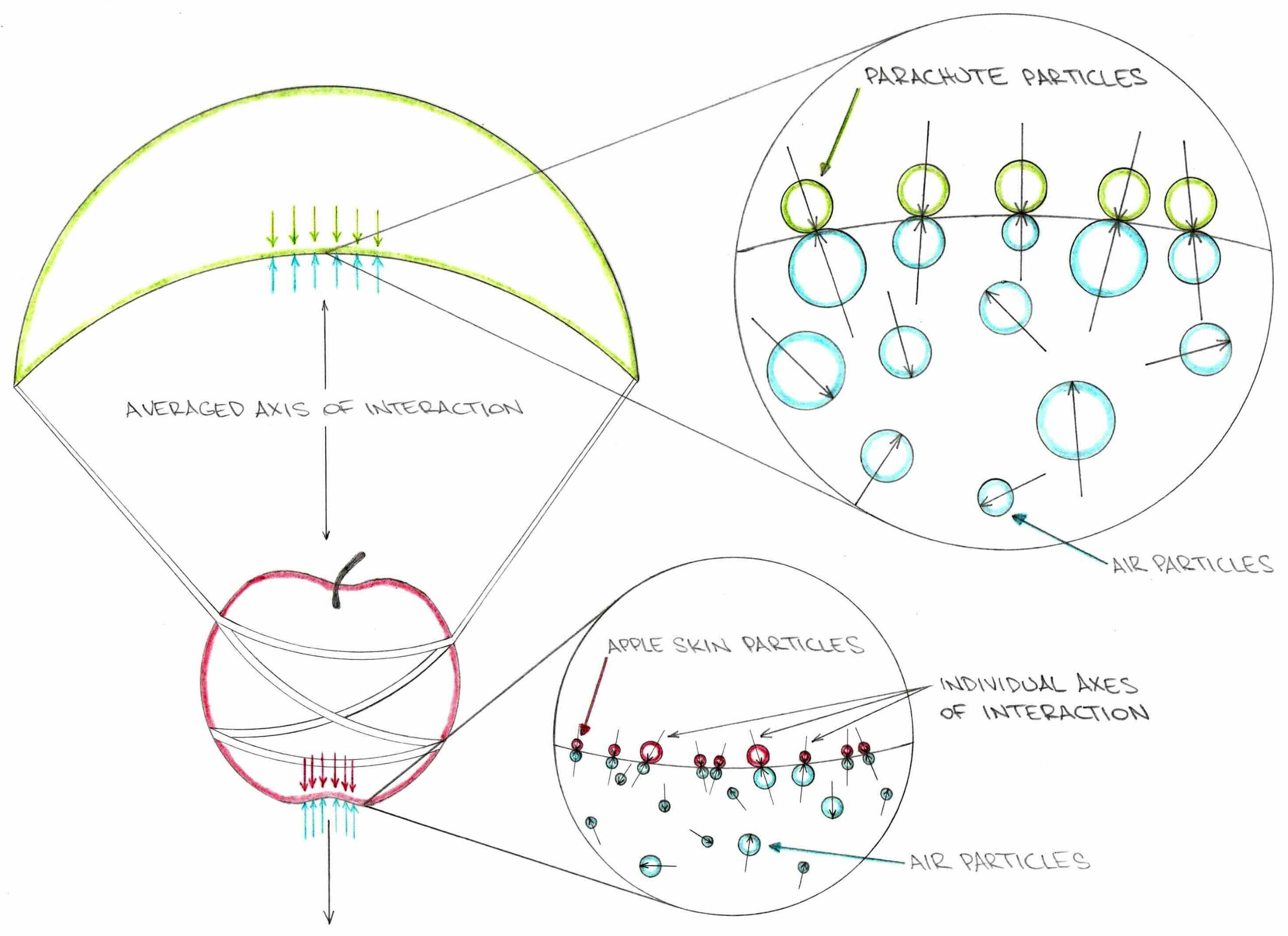
Figure 6.1: Axis of interaction.
The reason I feel this little musing may be of importance is that it would paint a picture within any system of objects and particles that exist within a field of gravitational influence, where there exists a general axis of higher interaction rates/energy/mass that points towards the centre of the most influential mass of that system, and amongst all these interactions this axis would be more strongly represented the closer one gets to the centre of that mass. In fact perhaps we could even say that the most influential mass of that system is only such because of the accumulation of all of these little axes from all of the particle interactions that make up that system? This is very similar to Einstein’s description of gravitational influence as spacetime curvature, where the closer one gets to the centre of a massive object, the greater the spacetime curvature, and the greater the gravitational influence.
So if we now think about our person in a the small windowless room within the field of Earth’s gravitational influence, where their apple would fall at 9.8 metres per second squared, perhaps we could imagine that the reason why this person and their apple feel the effects of gravity, is because the axes of interaction/energy/mass of all of the particles in the system surrounding their small room, including all of those particles extending through the atmosphere and into space that exist above this room, all align in a way that most greatly describes a straight up-down axis of gravitational influence towards the centre of Earth’s mass. Even when there are differently pointing axes in this system, I expect that in normal circumstances, these will simply never outnumber the overwhelming accumulation of axes influenced by such a massively (pardon the pun) influencing object like the Earth and her atmosphere.
There’s an intuitive quirk to all of this too, in that because these gravitational effects are now based on particle interactions, we might be tempted to suggest that if we were to completely isolate the interactions within a box, we could prevent the accumulation of these interaction axes and thus thwart gravity (or perhaps more importantly, thwart this theory as this simply does not occur in reality). But these effects of gravitational influence do not stop at the boundaries of a closed system, because from a particle point of view there are no boundaries to these systems, only different kinds of interactions between different kinds of particles, through walls, or air, or whatever; and despite the effects of gravitational influence playing a much smaller role in the interactions of these elementary particles than those of the strong or weak or electromagnetic forces, these axes of interaction/energy/mass would still exist. Indeed it is at these elementary scales that I expect these axes of interaction/energy/mass would be most unambiguously defined, but whether we can observe this experimentally, without limiting the environmental conditions of the experimental system to such a degree that these results could in fact be unambiguous, is another question entirely.
Hypothetically though, because this theory is based on information within particle interactions accumulating to create a system-wide reinforced expression of gravitational influence, if one were to somehow create a completely closed system, with no information capable of spatially or temporally entering this system, then it might be possible to dupe gravity inside of it perhaps? But I also suspect that the idea of duping gravity might be more important here, because technologically I’m not sure if it’s possible to create a system that can be so effectively closed, or be so effectively closed and still be of practical utility, whereas perhaps if we could mimic the information that describes gravity in a system of particle interactions, we could create a faux gravitational influence strong enough to subvert the overwhelming influence of the Earth and her atmosphere. But perhaps this is again, just my love of science fiction.
When looking at this person in their small windowless room again, but in its equivalent inertial system — that of a rocket accelerating at 9.8 metres per second squared — we would see the same overwhelming axis of interactions/energy/mass in the straight up-down orientation, but rather than this being the result of an accumulation of these axes within the system of the Earth and her atmosphere acting upon the rocket from above, we would instead see this as a localised force acting from underneath all the particles and objects that define the system of the rocket. While within the rocket these particle systems could be seen to be equivalent, the exterior of the rocket in this second scenario would demonstrate a higher number of interactions along the rocket’s leading edge relative to the rest of its exterior, informing us that either the rocket is moving relative to the system around it, or the system around it is moving relative to the rocket. Once we also take into account the controlled explosive blast at the base of the rocket, able to propel it with respect to the system of space around it, we can deduce that this blast can account for the acceleration of the rocket through the universe, and not the acceleration of the universe past the rocket, thereby confirming our non-equivalence.
This is also a good point to start tying this all back to our time disc, because one of the most important realisations Einstein gave us with general relativity was not only how gravitational influences affect the apparent motion of objects in space, but also how they affect their apparent motion through time. In short general relativity predicts, and many experiments have confirmed, that clocks ticking closer to a massive object will seem to tick more slowly than those farther away. This effect is known as “gravitational” time dilation, which to distinguish from our earlier, special relativity example of time dilation involving Alice and Bob and their speeds relative to each other, is now more specifically referred to as “kinematic” time dilation. In general relativity gravitational time dilation is again due to four-dimensional spacetime curvatures. How might we account for this as a result of relative particle interaction rates instead?
Let’s say that our person in their rocket on the surface of the Earth is wearing a watch. Let’s give this person a name now, and call him Dave (as Alice, Bob, and Charlie are already otherwise engaged). Dave is a little like myself and favours mechanical wrist watches to quartz watches, with their audible ticks and their intricate systems of tiny cogs and springs (as well as their absence of tiny but consistent electric pulses that are actually measurable in the arms and chests of those who wear quartz watches, to say nothing of the additional electrical pulses of modern smart watches). The intricate systems of cogs and springs in mechanical watches can effectively become gravitational influence detectors by virtue of the fact that they are calibrated to tell the time within the particle interaction environment that we experience at the Earth’s surface. What I mean by this is that the cogs and springs in Dave’s watch are designed to provide their predictable ticks given their resistance to the volumes of particle interactions that they are surrounded by here at Earth’s surface. Of course this is not how one would traditionally think of the calibration of the various forces and resistances that make a mechanical watch run on time, but relative to this theory at least this is another way we could think about it. You see, by thinking of gravitational influence by way of axes of interaction rates/energy/mass we can not only calculate the overall gravitational trend of a system based on its particle interactions, but because each of these interactions represent relative expressions of mass/energy, we should theoretically be able to calculate how much resistance these interactions offer to other systems of particles (like those that make up the springs and cogs of a watch) when they are at different places within a field of gravitational influence.
Dave’s watch is calibrated to tell the correct time on Earth’s surface, but when he goes up in his rocket and stops in a stable, let’s say geosynchronous orbit in space (effectively meaning it maintains the same relative position above the Earth as it rotates) and now at a much greater distance from the Earth’s central mass, the particle system at this orbital distance will provide different interaction-rate/energy/mass information to the particle system of his watch. At this greater distance from the surface of the Earth, the averaging of these axes which describe the trends in mass/energy alignments in the particle interactions in this system, will not be as clearly defined as a straight line towards Earth’s central mass, as it was at the surface of the Earth. With the reduced density of air particles outside the ship, as a result of it being in space, as well as more of the particles and objects falling to the Earth along less direct up-down axes (many of these particles may be in a stable orbit around the Earth in various opposing directions even), there would be a much less clearly defined gravitational influence here, and crucially less mass/energy directed along the same general axis. This means that according to this theory the cogs and springs in Dave’s watch will meet less resistance against the less clearly aligned particle systems in this rocket in space, which means that these cogs and springs will demonstrate greater energy here relative to when they were at Earth’s surface, and his watch will therefore tick more rapidly. This, I suggest, is another way — a particle interaction way — of understanding Einstein’s gravitational time dilation.
The same could possibly be said of Dave himself — his body’s own clock — as the nominal interaction rates of his body’s various systems have evolved to take place relative to the particle densities, and perhaps more importantly, the generally regular alignment of the mass/energy axes of these particle densities, that are present at Earth’s surface. Now that he’s in a rocket where these conditions offer less resistance to all of his body’s natural processes I expect these bodily processes may all “tick” more rapidly too, that is, more easily express greater interactions/energy over a common span of time relative to when he is on Earth’s surface. But the human body is more complicated than a watch and perhaps his body may initially “tick” faster, but might eventually reconfigure its processes to deal with this reduced alignment of mass/energy more efficiently; and perhaps for some bodily systems at least, even more efficiently than on Earth.
Additionally, given that Dave is actually travelling at a higher velocity in his geosynchronous orbit around the Earth than he would if he were stationary at the surface, we would also have to take into account the time dilation caused by Einstein’s theory of special relativity as well — kinematic time dilation — in conjunction, and in fact in this situation in opposition to this new gravitational time dilation. Because of this higher velocity we would find that Dave’s watch would slow down slightly relative to someone at Earth’s surface. However, because it would speed up more greatly from the effects of gravitational time dilation than it would slow down due to kinematic time dilation, the net effect would be that his watch would still tick a little faster overall. This is the case for most satellites anyway, whose internal clocks must be calibrated on Earth to run slightly slower than clocks on Earth, in order to make up for this net increase in time dilation when they are placed in orbit around the Earth.
If Dave’s rocket were engineered for an opposing kind of exploration, travelling towards the Earth’s central mass rather than away from it, then it’s interesting to think of the gravitational time dilation effects he might experience there also. Any region underground sufficiently closer to Earth’s central mass, would, in a spacetime curvature way of thinking, be in a region where the increased gravitational influence increases the spacetime curvature, making any clocks within this region run more slowly. In our new way of thinking about it though, we have not only increasing particle densities outside our now subterranean rocket, with increased interaction rates and thus increased energy exchanges in any common span of time compared to at Earth’s surface, but with these energy exchanges taking place in increasingly tighter alignments of interaction axes, we will presumably find the information that denotes gravitational influence as increasing energy and mass in specific alignments, becoming more concentrated towards the centre of the Earth. Even if Dave is sealed off from the particle densities outside his rocket, he cannot be sealed off from these alignments of mass/energy taking place among the elementary particle interactions within this entire underground system, including his rocket’s interior, which means that the cogs and springs of his watch will be presented with greater resistance from this new particle system, and will as a result, tick more slowly.
There is a subtle distinction to make here however. It’s true that the greater rate and mass/energy alignments of particle interactions closer to the centre of the Earth will cause Dave’s watch to tick more slowly, but this is not quite the same as slowing down time — in our new way of thinking about the relationship of time with energy and mass that is. Yes, Dave’s watch will tick more slowly, but we must remember this is because its cogs and springs are being presented with greater resistance from its surrounding particle system due to not only increased particle interactions, but also more greatly aligned axes of mass/energy information, pointing towards the centre of the Earth within all these interactions. So while the watch may tick more slowly compared to a watch on Earth’s surface, it is also being exposed to a far greater number of interactions within a common span of time compared to this surface watch, and due to natural processes of thermodynamics, similar to those presented to our chess piece earlier, all of the watch’s components will presumably deteriorate more quickly in this new system, likely shortening this underground watch’s lifespan relative to the surface watch.
We can think about Dave’s body here in a similar manner, and rather than framing it with reference to ticking clocks or watches, we must remember that what is really happening here is the various systems of Dave’s body are being exposed to a greater volume of particle interactions, and greater alignments of mass/energy in these interactions, resulting in a body that will have to work harder to maintain its equilibrium than if it were in an environment that it has evolved to live within.
I could imagine that dipping into these regions of higher gravitational influence might provide a particle interaction “workout” for his body though, training it to be more flexible in its adaptive abilities in a similar way to training our bodies’ muscles by exercising, and perhaps similarly providing a net benefit if done carefully. But the human body is not as simple as a ticking clock, and I expect there would be much to learn in all this if humans were ever to begin long-term habitation of regions of either greater, or lesser, gravitational influence.
Thinking about the effects of gravitational time dilation that affect Dave in this way also has an effect on the way that we must think about Alice, Bob, and Charlie as well. The problem for Dave, when he’s in a geosynchronous orbit in space at least, is that despite being in a rocket which is travelling faster relative to Alice over a common span of time, due to the all-pervading nature of particle interactions and their axes of mass/energy alignment that inform gravitational influence, it is impossible for Dave to be gravitationally isolated (at least within the current bounds of human innovation). The effects of gravitational time dilation would affect Bob and Charlie on their trains also, although Bob much less than Charlie.
To be honest I’m not particularly confident with the mechanics of all of this at the moment, particularly in relation to Charlie’s interstellar space travelling, as there is just so much I have yet to properly learn and understand, but my intuition at this stage suggests that with a theory of gravitational influence that is founded on particle interactions instead of spacetime geometries, we may find that the human organism may not be able to sustain prolonged space voyages travelling at the significantly greater speeds that we would require to begin proper interstellar exploration (at least through the mode of a spaceship under some form of propulsion, as opposed to possible intra-spatial modes like hypothetical wormholes).
Without the technological advancement of gravitational isolation of the interior of these spaceships, I expect that the particle interactions that the exterior of the spaceship would undergo at such high velocities, even in the relative vacuum of deep space, might make the exterior of the ship massive enough that it would begin exerting its own gravitational influence on the occupants of the spaceship. As I, albeit imperfectly understand it, this would be separate to the gravitational effects that can be accounted for as a result of the G-forces of a spaceship accelerating, decelerating, or turning, or the lack of G-forces and gravity when the ship is simply coasting along at speed. This new potential effect I am suggesting would be determined by particle interactions on the exterior of the ship and the resulting increases in the alignments of axes of mass/energy occurring in these interactions. Perhaps at certain speeds and thresholds these effects could be engineered to be beneficial to the occupants, creating a false gravity without the need for rotation of the spacecraft, but I do find myself wondering at what velocities these particle interaction rates on the ship’s exterior would begin exerting detrimental effects on the ship’s inhabitants, and whether interstellar travel could still be a feasibly healthy enterprise, for single-generation humans at least.
I personally suspect that the human race’s ability to explore the universe at large will not depend on a propulsion mode of transportation. I actually do not believe it will even depend on space travel, but my theories about this will not likely be part of this current work. They do however begin with what we are about to explore next. A return to musings about light, and how we might represent light on our time disc.
~
SIDE TWO— Track 7 —
Light and Its Eternal Present
“The whole fifty years of continuous brooding have not brought me nearer to the answer to the question ‘What are light quanta?’ Nowadays every Tom, Dick, and Harry thinks he knows it, but he is mistaken.”
~ Albert Einstein, 1951
To be continued...
~
Last Track | Track List | Next Track
— Outro —
Without wanting to leave you on a cliffhanger Dear Readers, I’m sorry to say that I must, because the rest is yet to be finished in a way that’s worthy of your continued attention. And I’m hoping that you might be able to help me with this. As mentioned at the top, I don’t exactly know what help will get me over the line with it all. Whether it’s a few kind words, a reality check, some form of collaboration, sharing with others, or a monetary gift, I am happy to lay my trust in the mystery of the world’s unfolding. I thank you in advance for any of these, or more — or perhaps most importantly, simply for your precious time thus far.
You can reach out to me at:
- [email protected]
- substack.com/@stillpointpaul
- x.com/stillpointpaul
Or buy me a coffee / financial contributions can be made via:
- ko-fi.com/stillpointtheory
With deepest gratitude,
Paul Knox
~
Last Track | Track List | Next Track
— Bio —

Over thirteen years ago I had an experience that some might describe as an enlightenment.
I was on day three of a ten day silent meditation course. Day three of sitting silently on the floor for over ten hours a day — and I was in agony. It was what I would later come to realise as more psychosomatic than actual agony, but at the time it was manifesting as intense and unrelenting pain in my legs and lower back, accompanied by a consistent battering of silent self-deprecation. Just when I felt I could bear it no more, let alone for another seven days, just when I was about to throw in the towel and leave the course, out of the blue all that pain and self-inflicted suffering peeled away from me; lifted off me like an old scab that was finally ready to just to fall away, and in the place of that pain was the most awe-inspiring experience I’ve ever had. For what could have been half an hour, or an hour perhaps, I don’t really know, I quite literally felt as light as a feather, and inhabited a whole new world of brightness and beauty; of clarity, and most of all, of peace. Complete and utter peace, and joy, and contentment.
I had often thought about other possible experiential realities prior to this moment. Spiritual realities perhaps, or simply states of altered perception that sometimes seep through the cracks of our otherwise orderly lives, but I had never known anything that had completely overturned all prior lived experience in the ways that this experience had, and I have not known anything quite like this since then either. As the normalcy of my human be-ing began to realign within me, and ground me back in my body in place and time, I sensed that I would never quite see the world the same way again. A few days later, while still on that meditation course, the seed of an idea was planted in my mind that has led to this work that I’ve called Still Point Theory.
I have no right to have any authoritative opinion on the science and philosophy that is teased apart in this work. I am not a scientist. I have no degree in philosophy. I’m a camera assistant in the film and television industry most of the time, here in Brisbane, Australia, and I’m taking a bit of editing work now too. To help keep myself afloat in these new economic conditions here, I’m doing some gardening as well. Working with the land and devising systems for greater balance and fertility is something that gives me a sense of purpose and achievement that not much else in my life does, aside from fatherhood, and my personal writings. I’ve had a rather convoluted and atypical path through my adult life, and so I have no worldly achievements to lay claim to really, certainly none that I would put higher than being a good and loving father, but if I had to suggest why I am here on this Earth, for any reason other than fatherhood, it would be the following:
I believe I am here because of my ability to see new ways through challenging problems and ideas. For whatever reason, the combination of my personality and my lived experience has created in me an intense joy for uniting disparate elements or ideas, finding deeper commonalities or unlikely connections, and bringing them into a more unified whole. I find this in gardening, as well as in creative pursuits. I used to dabble with this ability through writing fiction (just a hobby really, and never published), and if this still point theory turns out to be a work of fiction also then I'll (rather eagerly actually) merge back into this lane with my writing once again. My point here though, is that I never felt so alive as I did when a single idea helped to draw together so many others, to reveal a story in a whole new way, and in what felt like the way it was always meant to be. And I have never had this feeling as frequently as I have while thinking about, researching, and writing this thesis.
Formulating and writing Still Point Theory has been one of the greatest joys of my life so far, and I am so immensely grateful for this seed of an idea that was gifted to me over thirteen years ago — more so even, than the enlightening experience that preceded it.
~
— Feat. —
Leading Epigraph: Poem excerpt of "Burnt Norton II", written by T.S. Eliot in 1936, later compiled into Four Quartets, copyright 1943 by T.S. Eliot, renewed 1971 by Esme Valerie Eliot, reproduced here with permission of Faber & Faber Ltd. All rights reserved.
~ Eliot, T.S. (2019). Four Quartets, Faber & Faber.
Words and quotes of Albert Einstein referenced from:
Track 1 Epigraph: Professor Albert Einstein, 1954. Correspondence with David Bohm.
~ Stachel, J. (2002). Einstein from ‘B’ to ‘Z’, Birkhäuser.
Track 1 Body Quote 1: Prof. Einstein, 1916. Correspondence with Walter Dällenbach.
~ Stachel, J. (2002). Einstein from ‘B’ to ‘Z’, Birkhäuser.
Track 1 Body Quote 2: Prof. Einstein, 1954. Correspondence with Michele Besso.
~ Stachel, J. (2002). Einstein from ‘B’ to ‘Z’, Birkhäuser.
Track 2 Epigraph: Prof. Einstein, 1926. Correspondence with Max Born.
~ Pais, A, (1982). Subtle is the Lord, The Science and the Life of Albert Einstein, Oxford University Press.
Track 3 Epigraph: Prof. Einstein, 1955. Correspondence to family members of recently deceased Michele Besso.
~ Calaprice, A. (2010). The Ultimate Quotable Einstein, Princeton University Press.
Track 4 Epigraph: Prof. Einstein, 1927. Spoken informally at a dinner party in Berlin.
~ Kessler, H. (2000). The Diaries of a Cosmopolitan: 1918 to 1939, Phoenix Press.
Track 5 Epigraph: Authored by Prof. Einstein, 1952.
~ Einstein, A. (1961). Relativity and the Problem of Space (Appendix V, 15th Edn of “Relativity: the special and general theory”), Crown Publishers.
Track 6 Epigraph: Authored by Prof. Einstein, 1917.
~ Einstein, A. (1917). Cosmological Considerations in the General Theory of Relativity, Proceedings of the Prussian Academy of Sciences.
Track 7 Epigraph: Prof. Einstein, 1951. Correspondence with Michele Besso.
~ Einstein, A. & Besso, M. (1979). Correspondence 1903-1955, Herman.
Record vinyl cover art by Paul Knox, with record vinyl image element from Adobe Srock, image by OKAN.
~
— Hidden Track —
Before we part ways for now Dear Reader, I wanted to share one final thought, something that has only more recently entered my sphere of direct enquiry, and which I rather suddenly and distinctly felt compelled to share. I hope that with this last commentary, I do not overstay my welcome.
I have always considered myself a spiritual person. In the first chapter I even stated my belief in a “grand connection, a universal consciousness, an inherently relational and unifying ‘spirit’ that lies at the heart of all things.” It has taken me many years to write this thesis, but it’s only been in this last year that I have discovered that this universal consciousness I have been ambiguously alluding to, within my private rationalisations of spiritual intuition, has actually been the promise of a fully-fledged relationship with God.
It never struck me that this abstract concept that I had imagined, and that I was presuming everyone else was somewhat less-rationally, or perhaps just optimistically, referring to as “God,” was so much more than a spiritual rationalisation. It never truly struck me that this idea of God was not just an idea, or even an inherently limited mental approximation of a higher consciousness of some sort, but rather, a true understanding of God is intrinsically a relationship. A direct relationship with what I now feel to be not just a consciousness, but a consciousness so far beyond human, cardinal-consciousness-level fathoming (but importantly, according to this theory, not separate from it either), and quite literally existing beyond our human-constrained concepts of space and time, that in order to engage with it directly and truly, one has to principally feel it in your heart and body (emotionally and intuitively), more so than among the intellectual sounding boards of our minds. This, I’ve realised, is exactly what one would expect from a “relationship with God,” rather than mere “understanding of God,” is it not? I believe also, that this was one of the key messages of the man historically known as Jesus of Nazareth — Jesus Christ.
Whilst I feel this fits quite well within the framework of hierarchies of consciousness I have presented here, due to this inherently emotional and intuitive relational nature of our interaction with this consciousness, I feel that this framework, and the idea of perhaps an ultimate “divine consciousness” of our universe, cannot sufficiently encapsulate what I now believe God to be either. Without a corresponding intuitive or emotional appeal, I’m unconvinced that God can be truly captured with words and concepts alone.
It has taken me thirteen years of working on a theory that suggests that there is nothing in the universe that is not in relationship with something else, to realise that everything I have been working on in this theory has been pointing me towards a personal relationship with God, and more recently still, his incarnation as a human being here on Earth in Jesus Christ — which despite it’s seemingly illogical and irrational claims in the historical accounts of our species, I believe might be more readily explained, or at least more readily debated, as a result of the many propositions I put forward with this work. And the reason I mention all of this is not as an act of self-sabotage in the presence of my audience of scientists, and philosophers, or perfectly ordinary deep-thinking and curious people, who in our modern times might consider such thoughts to be rather quaint and unserious, and therefore automatically diminishing the weight of this work as a whole; but instead because I simply wish to bring to the attention of you, my Dear Readers, that nothing I have said in this work so far, in all of the new interpretations of science and philosophy that I’ve suggested, does anything stand in the way of my new-found relationship with God. In fact I believe it to be quite the opposite.
What I hope to share with you all eventually, whether it be in the completion of this thesis, Still Point Theory, or in a more specifically-oriented follow up, is that the principle of interaction, and all of the new possibilities I feel it presents to science and philosophy, seems to align with incredible beauty and precision to so many notions that have been revealed to me in more recent theological pursuits also. Whether it be right at the very beginning of the Bible, in Genesis 1, “And God said, Let there be light: and there was light” and the relevance of these words to our placement of light on our time disc (yet to be explained to you all though); or Jesus’ death and resurrection as being what I think of as a possible still point node, an anchor for our species outside of space and time, which all of us can access if we merely have the will, and the courage, and the faith to do so.
But perhaps most startling among the many examples I’ve so far pondered, and being especially relevant to the last chapter of this current work, are correlations between the time disc and some of the most difficult-to-grasp concepts in the Abrahamic faiths, particularly that of a spiritual afterlife, and with it notions of Heaven and Hell. It is my belief that with the deeper exploration of relativity as offered by this time disc model, we can begin making more serious logical arguments about possible states of being in the afterlife, as granted to us by accounts like those in the Bible.
If you would like to begin contemplating some of this on your own, I would suggest that you could think about the curious correlation between the greater alignments of interaction rates/energy/mass that our friend Dave experiences as he travels closer to the Earth’s central mass in his subterranean rocket, and how this results in a relative slowing down of time when compared to when he’s farther away from this central mass. It’s not only that there’s an interesting correlation between our archetypal depictions of Hell, as being underground and therefore within a field of greater gravitational influence, and thus interaction frequency/intensity, where just such effects would be most easily relatable to human experience,* or even the notion that our human interpretation of time here might seem stretched (and perhaps in their extreme like a relative “eternity” of suffering), for me it is also the idea of what it’s opposite might be.
*[It’s also interesting to think that besides these depictions of the underworld (which is perhaps more Graeco-Roman inspired than Biblically), there is also the description, again in Genesis 1, of “darkness [was] upon the face of the deep.” The other place on Earth that brings us into direct experience of what I’m calling these greater alignments of interaction rates/energy/mass, is the high pressure environments of deep water, where the deeper you go, the greater the pressure (and therefore the greater the interaction frequencies are), and the darker and more absent of “light” it becomes. If the words of divine inspiration were attempting to impress upon our psyche an intuitive appreciation of what the universe is like in the absence of God’s presence and love, I could not think of two better examples for our Earthly experience as humans.]
If you consider where Hell might be on our time disc, a region, let’s say, of the most intense particle interactions possible, we would have to imagine that the “deepest pits of Hell” would have to be on the farthest possible edge of our time disc, requiring the greatest amount of universal turning possible over the life of our universe, possibly to the point of being such a relativistic extreme that it becomes a theoretical infinity — even, I would suggest, in an ultimately finite universe. Although this sounds like a contradiction in terms, I do believe this is possible, especially when we imagine what might theoretically exist beyond the bounds of our own universe, and with the broader understanding of time afforded to us by this theory (and with a full explanation of forthcoming in future writing).
When one considers the opposite to this however, what we might call Heaven, I expect one would find themselves at, or nearer to, the centre of the time disc — the still point of the turning universe (nice to know I could more officially reveal the meaning of the title after all), and when we ponder the possibilities of what this still point represents, not just in a spiritual sense, but in a rational, relativistic, possibly-one-day-measurable and -scientific sense as well, I find the correlations truly astonishing. So astonishing in fact, that I believe proper rational debate around these ideas may help us overcome the cognitive barriers associated with the more “supernatural” aspects of Christianity and Judaism, but perhaps most importantly, without minimising or compromising the role of faith. I believe that faith will always be required in one’s own spiritual development, if for no other reason than what I expect to be inherent limitations at the relativistic extremes of the universe, which distinctly prevent the possibility of objective observation or measurement. I believe the universe has its own relativistically-built-in indescribability, and therefore must be inherently personal at these extremes.
As I have said a few times already though, we have more ground to cover before making full sense of ideas like these. But given the incredible benefit that I have received over the last year, by making this idea of the innately relational nature of the universe an actual experiential reality through my new-found relationship with God, I simply wanted to suggest to you all that it’s never too soon for any of us to begin our own exploration, our own relationship, with the mystery at the centre of our universe.
And to think, all of the ruminating, and meditating, and discussing, and withdrawing, that I have done in my life to try to get closer to the meaning of it all… When it seems all I truly needed was prayer. Heartful prayer.
“If I understand all mysteries, and have all knowledge, and have all faith so as to move mountains, but have not love, I am nothing.”
~ Apostle Paul, First Letter to Corinthians, 13:2, circa AD 53
Last Track | Top | Track List
© Paul Knox 2026 All Rights Reserved